MiroFish’s ‘God’s Eye’ AI: In the high-stakes world of product launches, “hope” has never been a strategy. Yet, for decades, entrepreneurs have relied on backward-looking sentiment analysis or expensive, small-scale focus groups.
Enter MiroFish, an open-source “swarm intelligence” engine that is currently disrupting how we predict the future. Often described as a “God’s Eye View,” MiroFish doesn’t just analyze data—it builds a digital parallel world and populates it with thousands of AI agents to see how they behave before you ever ship a product.
Table of Contents
The “God’s Eye” Architecture: How It Works
Traditional AI tells you what people said. MiroFish shows you what people do. It follows a sophisticated five-stage pipeline that transforms static information into a living, breathing social experiment.
1. Seed Extraction (GraphRAG)
MiroFish starts with “seed material”—your product specs, a news article, or a marketing plan. Using GraphRAG (Graph-based Retrieval-Augmented Generation), it builds a complex knowledge graph. It identifies the entities (buyers, competitors, influencers) and the invisible tensions between them.
2. Spawning the “1,000 Buyers”
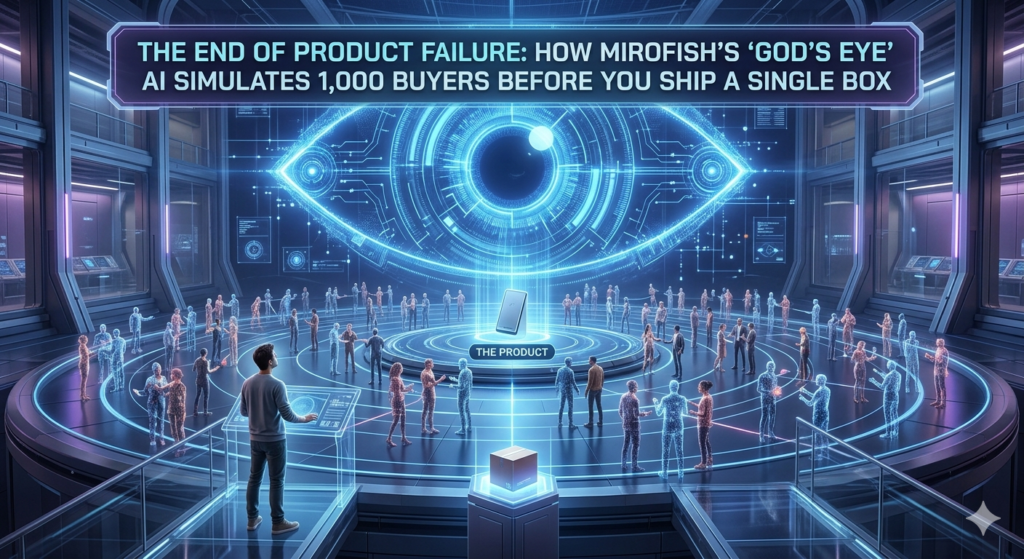
Instead of one generic AI, MiroFish generates hundreds or thousands of Agent Personas.
- Unique Logic: Each agent has a distinct background, socio-economic status, and set of biases.
- Long-Term Memory: Powered by Zep Cloud, these agents remember previous interactions, allowing their opinions to evolve over “simulated weeks.”
3. Dual-Platform Parallel Simulation
The agents are dropped into two parallel environments—one mimicking the rapid-fire chaos of Twitter (X) and another reflecting the community-driven debates of Reddit. Powered by the OASIS framework (developed by CAMEL-AI), these agents post, argue, repost, and form “echo chambers” or “hype cycles” just like real humans.
4. Emergent Prediction (The ReportAgent)
After the simulation runs (often for 30–50 rounds), a specialized ReportAgent analyzes the results. It doesn’t give you a “yes/no” answer; it provides a map of emergent behavior:
- Where did the narrative break?
- Which buyer segment turned hostile?
- What “unforeseen” variable caused the product to fail?
Why “1,000 Agents” is the Magic Number
While a single LLM (like GPT-4) can summarize a trend, it cannot simulate Swarm Intelligence.
“Complex outcomes—like a market crash or a viral hit—emerge from the interaction between individuals, not from the individuals themselves.”
By simulating 1,000 unique buyers, MiroFish captures the “messy social dynamics” of the real world—the persuasion, the herding behavior, and the radicalization that traditional data models miss.
Use Cases: Beyond Marketing
| Domain | Application |
| Market Strategy | A/B test your campaign narrative on 1,000 simulated buyers to find the highest conversion path. |
| Crisis PR | Predict how a university controversy or corporate scandal will evolve on social media before it goes viral. |
| Financial Forecasting | Simulate how retail vs. institutional investors will react to an earnings report. |
| Creative Writing | MiroFish famously simulated the “lost ending” of the 18th-century classic Dream of the Red Chamber by letting character agents play out their motivations. |
The Reality Check: Costs and Constraints
As revolutionary as MiroFish is, it’s not a “free” crystal ball.
- Token Burn: Running 1,000 agents through 40 rounds of interaction generates a massive volume of API calls. It is computationally expensive.
- Herd Bias: AI agents can sometimes polarize or “radicalize” faster than real humans, meaning the simulation might show an extreme version of reality.
- Vibe Coding: Built in just ten days by a 20-year-old developer (Guo) and backed by $4M in funding from Shanda Group, the project is still in its “early-access” frontier phase.
God’s Eye AI Simulates 1,000 Buyers Before You Sell Anything — MiroFish Explained
The Future of Decision Making
MiroFish marks a shift from Equation-based Forecasting (solving for X) to Emergence-based Simulation (watching what the people decide X is). It is a “flight simulator” for business, allowing you to crash 1,000 times in the digital world so you can fly once in the real one.
Nvidia NemoClaw vs. OpenClaw: Is Your AI Agent a Security Risk?
You may join my Twitter Account for more news updates, Wordle, and more game answers & hints daily.