The federal minimum wage has been frozen at $7.25 since 2009—the longest period without an increase since the floor was first established in 1938. But in April 2026, a bold new proposal hit the House floor that aims to shatter the status quo.
Introduced by a coalition of progressive lawmakers, including Representatives Delia Ramirez (IL), Jesús “Chuy” García (IL), and Analilia Mejia (NJ), the Living Wage for All Act seeks to raise the federal minimum wage to $25 per hour.
Table of Contents
The Fight for $25 Minimum Wage: Why Congress is Pushing for the Biggest Wage Jump in U.S. History
Here is everything you need to know about this landmark legislation and what it could mean for the American workforce.
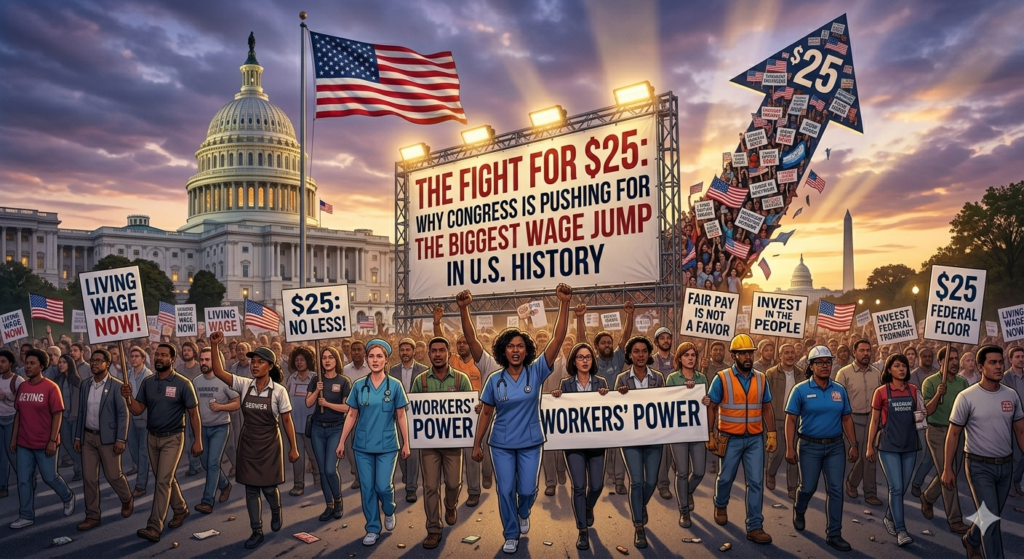
1. The $25 Vision: A Phased Approach
The bill doesn’t jump to $25 overnight. Recognizing the complexity of the modern economy, it proposes a two-track phase-in designed to give businesses time to adjust:
- Large Corporations: Highly profitable companies and large employers would be the first to move, reaching the $25 mark by 2031.
- Small Businesses: Smaller employers would have a longer runway, gradually scaling up to reach the $25 floor by 2038.
2. Ending the “Sub-Minimum” Wage
One of the most transformative aspects of the bill is the elimination of all sub-minimum wages. Currently, federal law allows certain workers to be paid significantly less than $7.25. The new bill would mandate a full wage for:
- Tipped workers (who currently have a federal base of just $2.13).
- Youth workers.
- Workers with disabilities.
3. Future-Proofing Against Inflation
To prevent the wage from stagnating for another 17 years, the Living Wage for All Act includes an automatic adjustment mechanism. Once the $25 target is reached, the minimum wage would be indexed to typical wages across the economy. As the economy grows and average pay rises, the floor would rise with it—automatically.
4. Why $25? The Affordability Crisis
Proponents of the bill argue that $15—once the “gold standard” for labor activists—is no longer enough to survive in 2026.
- The Cost of Living: With surges in housing, gas, and groceries over the last several years, supporters argue that $25 is the new “survival floor” required for a family to thrive.
- Corporate Profits: Lawmakers have pointed to record-high corporate earnings as evidence that the wealth is not “trickling down” to the frontline workers who generate it.
The Hurdles: Support vs. Opposition
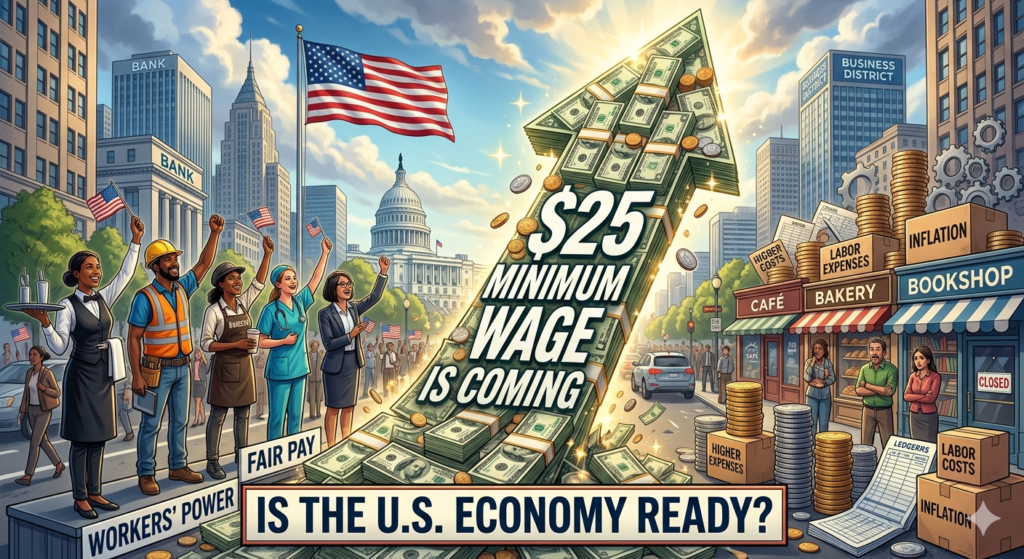
While the bill has strong backing from labor unions like the SEIU and progressive advocacy groups, it faces a steep climb in a divided Congress.
| Perspective | Key Arguments |
| Supporters | Stimulates the economy by putting money in consumers’ pockets; reduces reliance on public assistance; addresses the “wage crisis.” |
| Opponents | Argue it could “crush” small businesses; potentially leads to automation or job cuts; could contribute to further inflation. |
Current Context: The State-Level Shift
While the federal government deliberates, states aren’t waiting. As of 2026:
- 23 states saw minimum wage increases on January 1st.
- California has already implemented a $20 minimum wage for fast-food workers.
- Washington, D.C. maintains one of the highest floors in the country at nearly $18 per hour.
The Bottom Line
The Living Wage for All Act represents the most ambitious federal wage proposal in U.S. history. Whether it passes in its current form or serves as a catalyst for a smaller compromise, it has officially shifted the national conversation. The “Fight for $15” has evolved; the new battleground is $25.
PAY PAINS All 2,021 Home Depot locations brace for $25 policy under new ‘rate’ bill
You may join my Twitter Account for more news updates, Wordle, and more game answers & hints daily.