Bayesian Teaching: In early 2026, Google Research quietly shifted the foundation of how artificial intelligence learns. While the world was focused on the sheer scale of Large Language Models (LLMs), Google introduced Bayesian Teaching, a breakthrough that allows AI to evolve its understanding in real time during a single conversation.
Table of Contents
Forget LLMs: Google’s New Bayesian Teaching Is the Real Leap Toward AGI
Unlike traditional AI that remains static after its initial training, this “Bayesian” approach enables models to mimic human-like belief updates, transforming them from static encyclopedias into adaptive partners.
The “Static AI” Problem
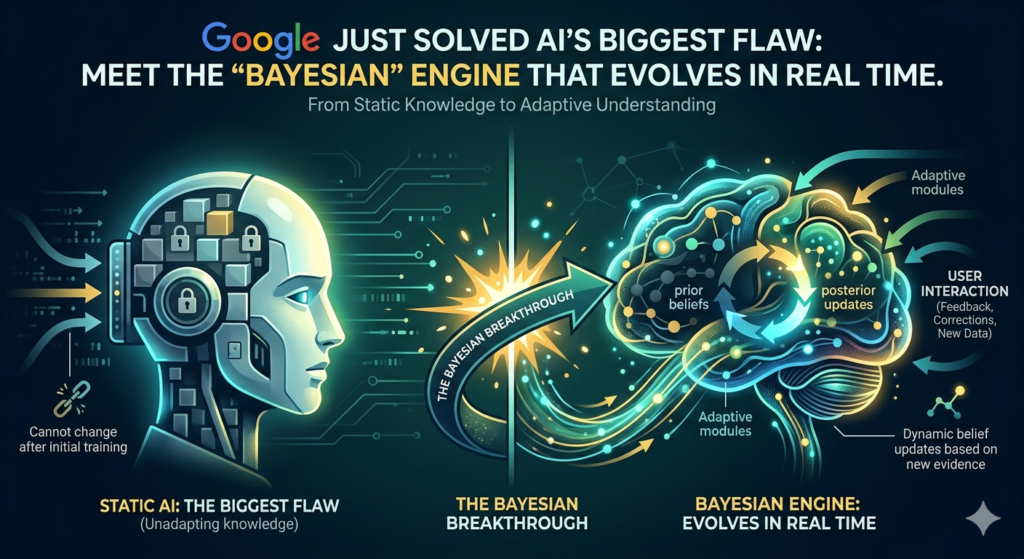
Until now, even the most advanced models like Gemini 1.5 Pro or GPT-4 had a fundamental flaw: they were “flat learners.”
In a multi-round conversation—such as planning a complex travel itinerary—if a user rejected a flight because of a specific layover preference, the AI often struggled to “weight” that preference correctly in the next round.
It might suggest another flight with the same issue because its internal “beliefs” didn’t actually evolve; they were just filtered through a context window.
How Bayesian Teaching Works
Google’s new framework doesn’t just give the AI more data; it teaches the AI how to update its own probability distributions. * The Bayesian System: At its core, Bayesian statistics is about updating the probability of a hypothesis as more evidence or information becomes available ($P(H|E)$).
- The “Teaching” Phase: Google trains smaller models (like the Gemma family) by exposing them to simulated conversations between a user and a “Bayesian Assistant.” The model learns to imitate how a perfect mathematical system would shift its confidence levels after every piece of feedback.
- Real-Time Evolution: Because the model has “learned how to learn,” it can refine its predictions across multiple rounds of interaction without needing to be retrained on a server.
Performance Gains: A Comparative Look

In recent benchmarks involving recommendation tasks, the impact of Bayesian Teaching was immediate:
| Model Strategy | Initial Accuracy | Round 5 Accuracy | Growth |
| Standard LLM | 37% | 38% | +1% (Stagnant) |
| Supervised Fine-Tuning | 50% | 61% | +11% (Linear) |
| Bayesian Teaching | 57% | 76% | +19% (Exponential) |
Beyond Chatbots: The 2026 Ecosystem

This shift is part of a broader “Real-Time AI” rollout at Google that includes several other key technologies:
1. Project Genie 3
An infinite world model that uses similar Bayesian principles to generate 3D environments that load and adapt as you move through them. It doesn’t render a static map; it evolves the world based on the direction you walk.
2. D4RT (Deep 4D Real-Time)
A motion-aware model that interprets movement in continuous 3D space. While older models saw video as a series of still frames, D4RT understands the “probability of trajectory,” allowing autonomous systems to predict where an object will be before it moves.
3. Agentic Vision
Integrated into Chrome and the Gemini API, this allows the AI to “study” an image or screenshot through multiple steps. If it’s unsure about a detail, it zooms in and re-evaluates its “belief” about that pixel—a direct application of Bayesian uncertainty.
The Verdict: Why This Matters
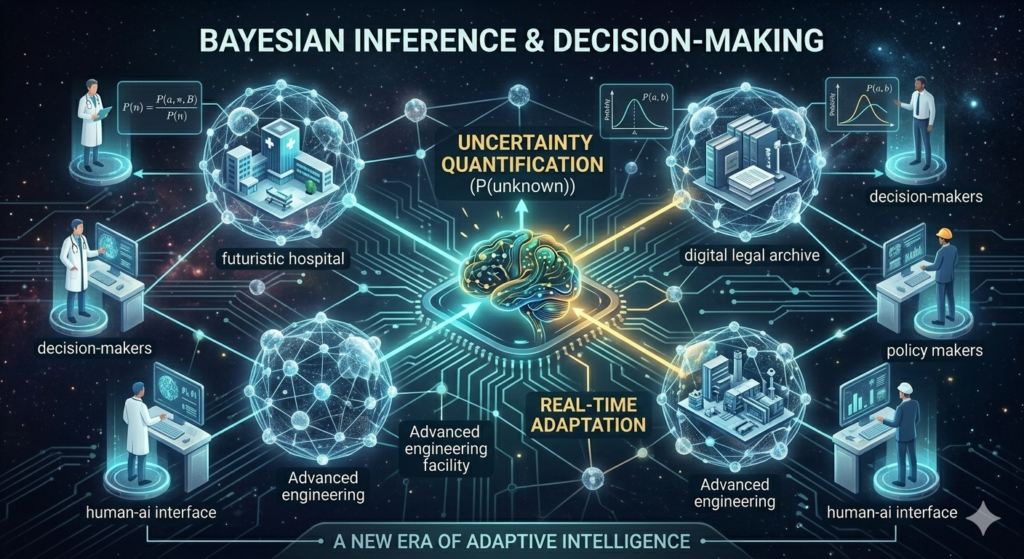
The “Bayesian Drop” marks the end of the “Stochastic Parrot” era. By moving toward models that treat every user interaction as a data point for a real-time belief update, Google is creating AI that feels less like a search engine and more like a colleague who actually listens.
As these models move into medicine, law, and engineering, the ability to quantify uncertainty (knowing what they don’t know) and adapt in real time will be the difference between a helpful tool and a truly intelligent agent.
Google Research Shows ‘Bayesian Teaching’ Helps LLMs Learn User Preferences Better
This video details the specific mechanics of how Google’s new Bayesian Teaching method outperforms traditional fine-tuning in making AI assistants more adaptive.
The Hospital Has a New Brain: Inside Stryker’s AI-Powered Digital Revolution
You may join my Twitter Account for more news updates, Wordle, and more game answers & hints daily.