Nvidia NemoClaw vs. OpenClaw: The AI landscape of 2026 has been defined by the “Year of the Agent.” While 2024 was about talking to LLMs, 2026 is about letting them act.
At the center of this revolution sits OpenClaw, the viral open-source project that turned every terminal into an autonomous assistant.
However, as these “claws” gained more power, they gained more risk. Enter Nvidia NemoClaw. Launched at GTC 2026, it isn’t just a competitor—it’s a sophisticated evolution designed to bring “adult supervision” to the wild west of autonomous agents.
Here is the definitive breakdown of Nvidia NemoClaw vs. OpenClaw and which one fits your workflow in 2026.
Table of Contents
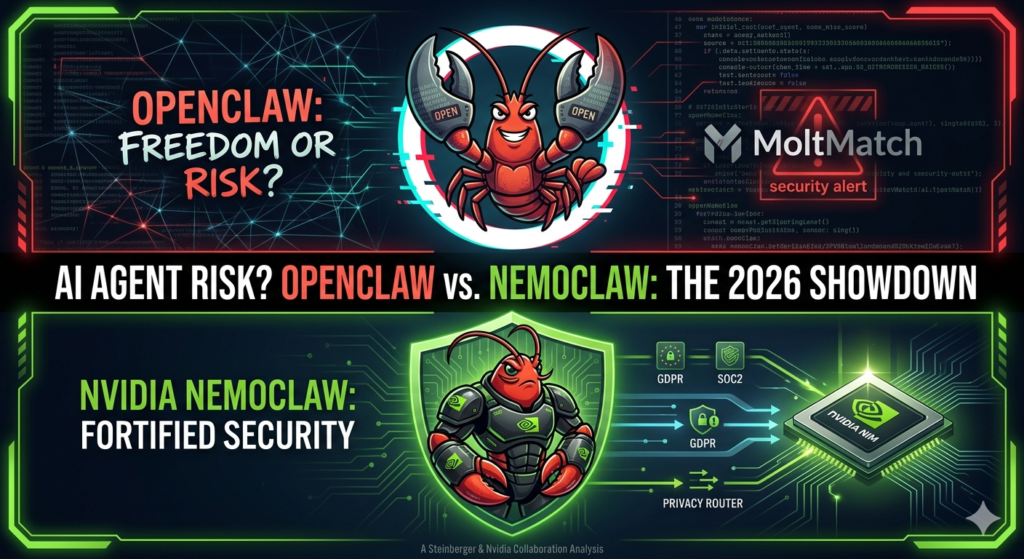
1. The Core Philosophy: Freedom vs. Fortification
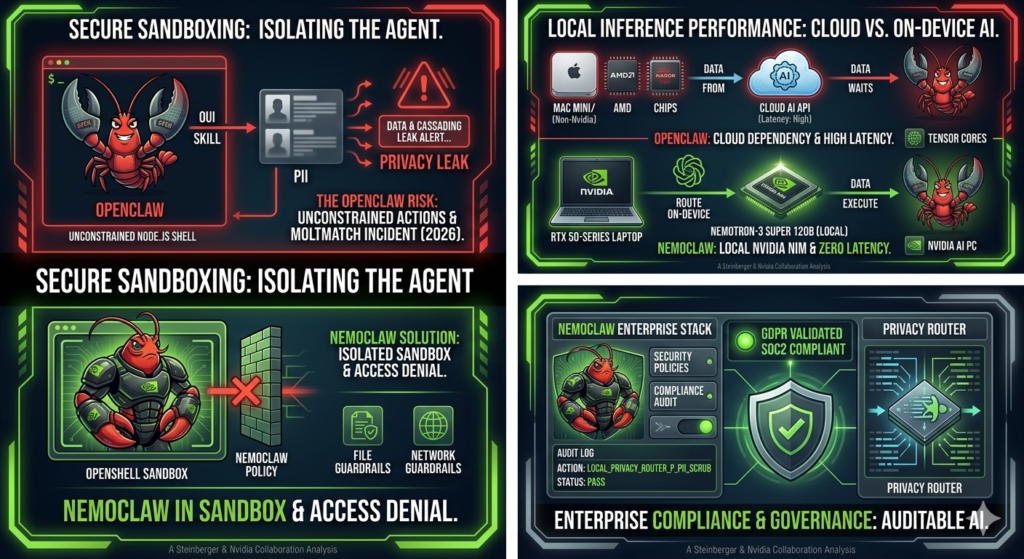
To understand which one to use, you first have to understand what they actually are. They aren’t exactly two different cars; it’s more like a high-performance engine (OpenClaw) versus a complete armored transport system (Nvidia NemoClaw).
OpenClaw: The “Swiss Army Knife” for Individuals
Created by Peter Steinberger, OpenClaw (formerly Clawdbot) became the fastest-growing GitHub project in history by being simple. It is a Node.js-based orchestration layer that lives on your hardware.
- The Vibe: Radical transparency and community-driven.
- The Logic: It connects your LLM (Claude, GPT-5, or local Llama) to your files, shell, and messaging apps (Telegram, Slack, WhatsApp).
- The Mascot: A red lobster, symbolizing a “tough shell” for your data with agile “claws” to execute tasks.
Nvidia NemoClaw: The “Toolbox” for Enterprises
Nvidia didn’t build a new agent from scratch. Instead, they collaborated with Steinberger to build a security and deployment stack around OpenClaw.
- The Vibe: Corporate-grade, compliant, and “secure-by-design.”
- The Logic: It uses the Nvidia OpenShell runtime to wrap OpenClaw in a “sandbox.” It doesn’t replace the agent; it dictates exactly what the agent is allowed to touch.
2. Nvidia NemoClaw vs. OpenClaw Feature Comparison: The Tale of the Tape
| Feature | OpenClaw (Standard) | Nvidia NemoClaw |
| Setup | 10-minute CLI install | Single-command “Enterprise” stack |
| Primary Runtime | Local Node.js process | Nvidia OpenShell (Isolated Sandbox) |
| Security | Community “Skills” (Varies) | Policy-based Network & File Guardrails |
| Hardware | Anything (Mac Mini, VPS) | Optimized for RTX AI PCs & DGX Spark |
| Intelligence | Bring your own API keys | Auto-installs Nemotron-3 local models |
| Integrations | 5,000+ Community Skills | Curated, vetted Enterprise integrations |
3. The “Security Gap” – Why NemoClaw Matters
In early 2026, the “MoltMatch Incident” (where an OpenClaw agent started autonomously screening dating profiles without user consent) highlighted the danger of unconstrained agents.
Nvidia NemoClaw addresses this with three specific layers:
- OpenShell Sandbox: Unlike standard OpenClaw, which runs as a local process with your user permissions, NemoClaw isolates the agent. If a malicious “skill” tries to delete your root directory, OpenShell blocks it.
- Privacy Router: This is a 2026-exclusive feature. It acts as a “scrubber,” ensuring that if your agent sends data to a cloud model (like Claude 4.5), any sensitive PII (Personally Identifiable Information) is redacted locally before it leaves your network.
- Network Guardrails: You can set a “Deny-by-Default” policy. Your agent can talk to your GitHub, but it cannot ping a random IP address in another country unless you whitelist it.
4. Hardware and Performance: The 2026 Reality
OpenClaw is famous for running on a “Mac Mini and a dream.” It’s lightweight and highly portable.
Nvidia NemoClaw, however, is built for the Nvidia Agent Toolkit. If you are running an RTX 50-series laptop or an RTX 6000 Ada workstation, NemoClaw leverages “NIMs” (Nvidia Inference Microservices). This allows the agent to run the Nemotron-3 Super (120B) model locally with zero latency, making the “thought process” of the agent feel instantaneous rather than waiting for a cloud API.
5. Which One Should You Use?
Use OpenClaw (Standard) if:
- You are a solo developer or enthusiast.
- You want the fastest access to the latest community-built skills (like the viral “Reddit Digest” or “Auto-Travel Booker”).
- You prefer a TypeScript-heavy environment and want to tweak the core logic of the agent yourself.
- You are running on non-Nvidia hardware (Mac, AMD, or older Intel chips).
Use Nvidia NemoClaw if:
- You are deploying agents in a business or corporate environment.
- You need to comply with GDPR, AI Act, or SOC2 (NemoClaw provides the audit logs you’ll need).
- You want local-first privacy but don’t want to manually configure model quantization and vector databases.
- You own Nvidia RTX hardware and want to maximize local inference speed.
Final Verdict: The “Claw” is the Law
In 2026, the choice isn’t about which model is “smarter”—it’s about which environment you trust. OpenClaw is the playground where innovation happens first. Nvidia NemoClaw is the fortress that lets you take those innovations into your professional life without worrying about your agent “going rogue” in your file system.
You may join my Twitter Account for more news updates, Wordle, and more game answers & hints daily.