Netflix Just Bought the Iron Throne: In a move that has sent shockwaves from Hollywood to Silicon Valley, the unthinkable has happened: Netflix has officially agreed to acquire the studio and streaming assets of Warner Bros. Discovery for $82.7 billion.
This isn’t just another corporate handshake; it is the single most disruptive moment in modern media history. By absorbing the “Iron Throne”—the crown jewel of HBO’s library—and the legendary Warner Bros. film vault, Netflix is no longer just a streaming service. It is now the definitive custodian of global pop culture.
Table of Contents
Netflix Just Bought the Iron Throne—And TV Will Never Be the Same
Here are 5 ways this merger will change gaming and television forever.
1. The Death of “Streaming Fatigue”
For years, fans have complained about the “fragmentation” of content—the need to subscribe to five different apps just to watch their favorite shows. By bringing Westeros (Game of Thrones), Hogwarts (Harry Potter), and Gotham City (DC Universe) under the same roof as Stranger Things and Squid Game, Netflix is effectively ending the “Streaming Wars” through total annexation.
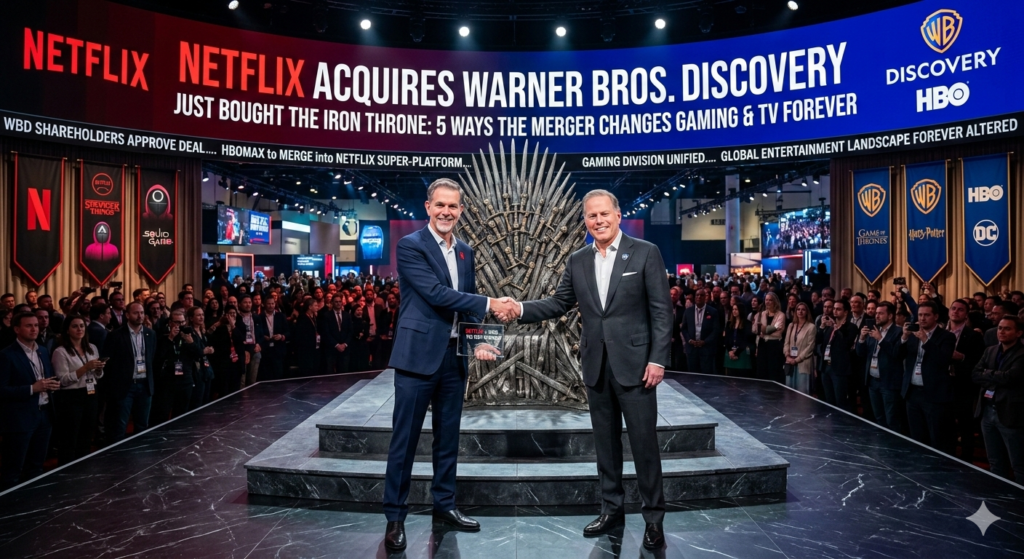
Expect a unified super-platform where the prestige of HBO meets the algorithmic efficiency of Netflix. This consolidation signals a return to a “one-stop-shop” model, likely forcing competitors like Disney+ and Apple TV+ to rethink their entire survival strategies.
2. The Rise of the “Transmedia” Empire
Netflix has been quietly building its gaming division, but it lacked the heavy-hitting IP to compete with Sony or Microsoft. That changed overnight.
- WBD Games Integration: Netflix now owns Hogwarts Legacy, Mortal Kombat, and the Batman Arkham series.
- The Playable Series: Imagine watching an episode of a new House of the Dragon spin-off and immediately jumping into a high-fidelity cloud-streamed RPG on your TV that lets you fight the same battle you just watched.
3. A New Era of “Interactive Prestigious TV”
HBO is known for high-budget, creator-driven narratives. Netflix is known for interactive tech experiments like Bandersnatch. Combined, we are looking at the birth of “prestige interactivity.” We could see “Choose Your Own Adventure” versions of the DC Universe where your choices dictate which hero survives the season, or a The Last of Us experience that bridges the gap between the show’s cinematography and the game’s tension.
4. The Global “Hogwarts” Effect
Warner Bros. traditionally leaned on theatrical releases and Western cable. Netflix, however, has an unparalleled global footprint in markets like India, Korea, and Brazil.
- Localized Spinoffs: Don’t be surprised to see a Korean-produced Harry Potter series or a Spanish-language Batman noir.
- Universal Access: By removing the “HBO” paywall in regions where it was difficult to access, Netflix is about to turn these legacy franchises into truly universal, daily-consumption habits for billions of people.
5. The “Theatrical-First” Pivot
In a surprising concession to secure the deal, Netflix has pledged a 45-day exclusive theatrical window for major Warner Bros. films. This marks a massive departure from Netflix’s “day-and-date” philosophy. This move essentially saves the movie theater industry from the brink of collapse.
By acting as a traditional studio for the big screen and a tech titan for the small screen, Netflix is creating a “hybrid” model that ensures blockbuster movies still feel like events before they become permanent residents of your digital library.
The Verdict
The Iron Throne has been moved to Los Gatos. While some worry about the lack of competition, the potential for a seamless, cross-media entertainment experience is undeniable. We are no longer just “watching” TV or “playing” games; we are entering an era of unified digital worlds.
New Evolution of Streaming Platforms: What’s Next After Netflix?
You may join my Twitter Account for more news updates, Wordle, and more game answers & hints daily.