China’s New AI Model PANDA: Pancreatic cancer is often called the “silent killer” because it is rarely detected before it has reached an advanced, inoperable stage. However, a breakthrough AI model from China, known as PANDA, is changing that narrative by spotting tumors that are virtually invisible to the human eye.
Table of Contents
What is China’s New AI Model PANDA?
Developed by Alibaba’s DAMO Academy in collaboration with over 10 medical institutions, PANDA (short for PANcreatic Detection with Artificial Intelligence) is a deep-learning algorithm designed to screen for pancreatic lesions using routine medical imaging.
The genius of PANDA lies in its ability to work with non-contrast CT scans.
- The Standard: Traditionally, doctors require “contrast” scans (which involve injecting a dye) to see the pancreas clearly.
- The PANDA Approach: It analyzes “plain” or non-contrast CT scans—the kind often taken for unrelated issues like back pain or kidney stones.
- The “Invisible” Edge: The AI can detect subtle changes in grayscale intensity that human radiologists cannot perceive, effectively turning every routine abdominal scan into a potential life-saving screening.
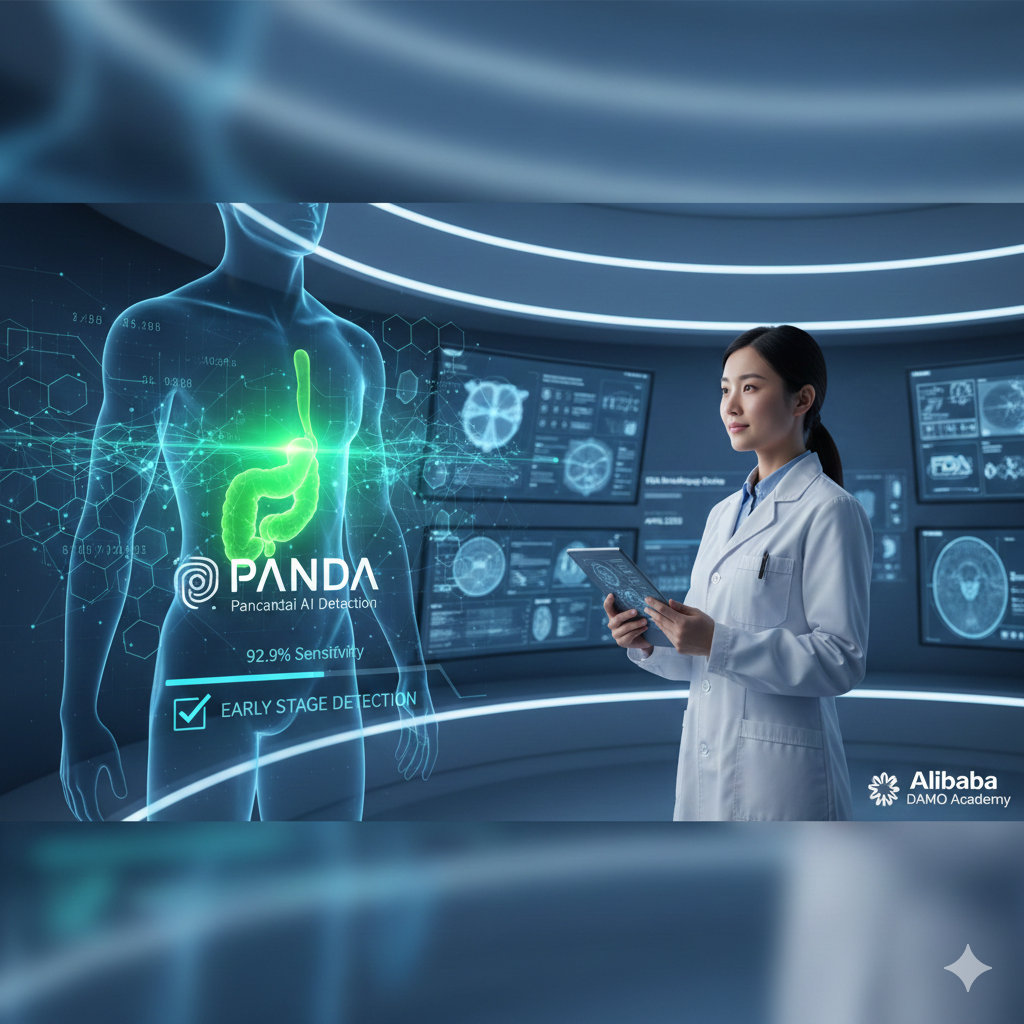
PANDA changes the game by:
- Seeing the Invisible: It detects subtle grayscale intensity changes in ordinary scans that the human eye cannot perceive.
- “Opportunistic” Screening: It can analyze routine CT scans taken for unrelated reasons (like a cough or back pain) to check the pancreas in the background.
- High Performance: In a study published in Nature Medicine, PANDA achieved 92.9% sensitivity and 99.9% specificity, outperforming human radiologists by over 34% in sensitivity.
Can it detect pancreatic cancer in the early stages?
Yes. Recent clinical evidence and large-scale studies suggest that PANDA is exceptionally effective at early-stage detection.
1. High Diagnostic Accuracy
In a major study published in Nature Medicine, PANDA was tested on over 20,000 patients. It achieved a 92.9% sensitivity (ability to correctly identify cancer) and a 99.9% specificity (ability to avoid false positives). Most importantly, it maintained high sensitivity even for small, early-stage tumors (T1 tumors).
2. Outperforming Human Experts
When compared to experienced radiologists, PANDA showed a 34.1% improvement in sensitivity. In real-world trials at hospitals like the Affiliated People’s Hospital of Ningbo University, the AI identified several cases that had been completely missed by human doctors during the initial review.
3. Global Recognition
The impact of this technology is so significant that in April 2025, the U.S. FDA granted PANDA “Breakthrough Device” status. This designation is reserved for innovations that provide more effective treatment or diagnosis of life-threatening diseases, accelerating its path toward global clinical use.
कैंसर के इलाज में AI ने कमाल कर दिया 2026 की पहली बड़ी उपलब्धि
The “False Positive” Trade-off
While PANDA is a powerhouse for early detection, it isn’t perfect. In one pilot program:
- The AI flagged roughly 1,400 scans as suspicious.
- After further testing, about two dozen cases were confirmed as cancer.
- The Catch: This means hundreds of healthy patients faced the temporary “terror” of a potential diagnosis and required follow-up tests to be cleared.
Medical experts emphasize that PANDA is a “sentinel,” not a surgeon. It acts as an early warning system that must always be followed by a human specialist’s confirmation.
The Future of PANDA
Following its success with the pancreas, DAMO Academy has expanded the “fruit-themed” lineup with a second model called GRAPE, which focuses on detecting early-stage stomach cancer.
By integrating these tools into public health check-ups, the goal is to shift cancer care from late-stage “crisis management” to proactive, early-stage “cures.”
The Quiet Fade of a Titan: D’Angelo’s Silent Battle and the End of an Era
You may join my Twitter Account for more news updates, Wordle, and more game answers & hints daily.