Google’s New Antigravity AI: In the high-stakes chess match of Silicon Valley, Google has just made a move that suggests they aren’t just playing for the lead—they are trying to change the board entirely.
Table of Contents
Google Just Fired the Shot OpenAI Wasn’t Ready For: Inside the Antigravity Revolution
In March 2026, the tech giant officially transitioned its experimental “Antigravity” project into a full-scale AI ecosystem, a release that industry insiders are calling the most direct challenge to OpenAI’s dominance since the debut of ChatGPT.
What is Google’s New Antigravity AI?
Contrary to the sci-fi name, Google Antigravity isn’t about floating cars. It is an “agent-first” integrated development environment (IDE) and orchestration layer. While OpenAI has focused on increasing the “IQ” of its models with GPT-5, Google has focused on autonomy.
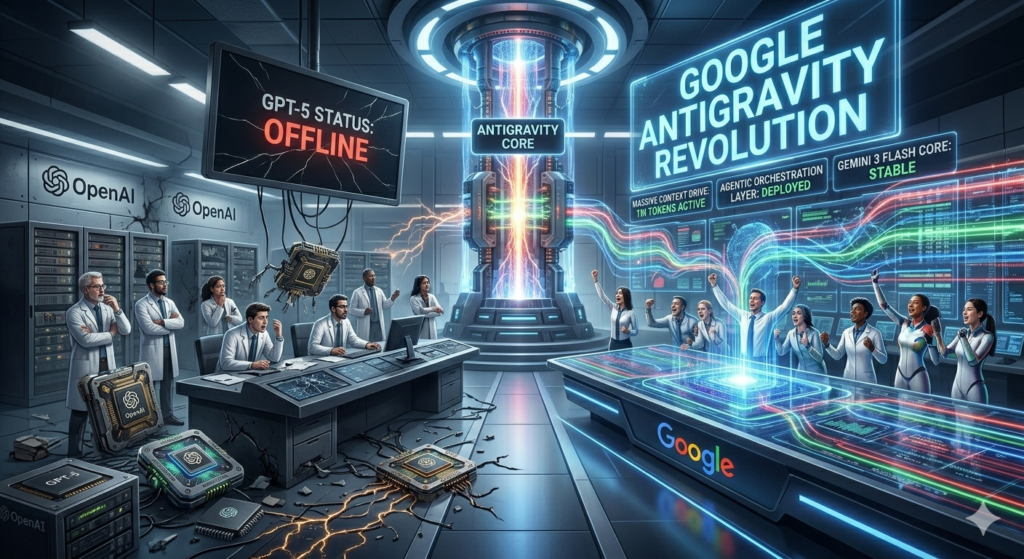
Antigravity is designed to handle “vibe coding”—a 2026 term for building complex, production-ready applications through natural language alone. Unlike a standard chatbot that suggests code, Antigravity acts as a project manager that can:
- Self-Correct: It uses internal feedback loops to verify its own work before showing it to you.
- Manage Infrastructure: It automatically spins up databases, handles user authentication (via Firebase), and manages API keys in a secure “Secrets Manager.”
- Multiplayer Orchestration: It can build and deploy real-time collaborative apps (like 3D games or shared workspaces) autonomously.
The Engine: Gemini 3 Flash vs. GPT-5
At the heart of this launch is Gemini 3 Flash, a model specifically tuned for the Antigravity environment. The “heat” on OpenAI comes from a shifting definition of “best.” While GPT-5 remains the gold standard for raw mathematical reasoning, Gemini 3 Flash is winning on utility and “context-gravity.”
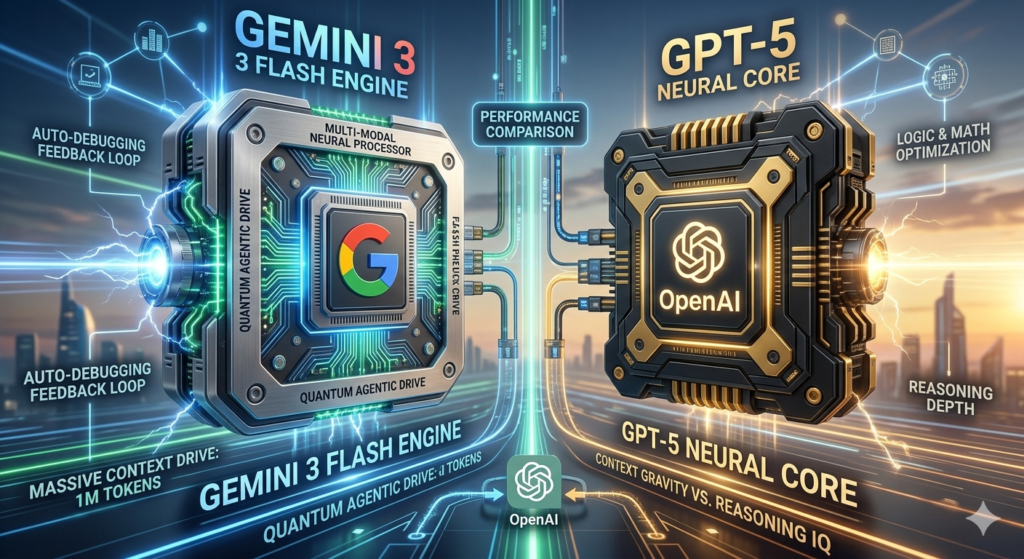
| Feature | Gemini 3 Flash (Antigravity) | OpenAI GPT-5 Mini |
| Context Window | 1.05 Million Tokens | 400,000 Tokens |
| Inference Speed | 167.6 tokens/sec | 69.6 tokens/sec |
| Primary Strength | Agentic workflows & Coding | Logic & Math |
| Pricing (per 1M) | $0.50 Input / $3.00 Output | $0.25 Input / $2.00 Output |
Why “Context” is the New “Intelligence”
Google’s massive 1-million-token context window allows Antigravity to “swallow” an entire codebase. While OpenAI users often struggle with “context drift” (where the AI forgets the beginning of a long conversation), Antigravity retains a perfect memory of the project structure, previous chat history, and architectural decisions.
The “Vibe Coding” Revolution
The most disruptive element of Antigravity is the Manager View. Traditional IDEs (like VS Code or Cursor) embed AI into a text editor. Antigravity flips this: it embeds the text editor into an AI Manager.
“We are moving from a world where you write code with an assistant, to a world where you direct an agent who writes the code for you.” — Industry Analysis, March 2026
In the Manager View, you can watch “Agentic Vision” in real-time. If you tell Antigravity to “fix the UI,” it doesn’t just give you a CSS snippet. It opens a built-in Chrome instance, inspects the elements visually, formulates a plan to “zoom and inspect,” executes the fix, and then records a video of the working result for your approval.
Google Just Dropped New Antigravity AI and It Puts Heat on OpenAI
The Friction: Quotas and “Agentic Overload”
It hasn’t been a perfect launch. As of late March 2026, Google is facing backlash over “Antigravity Restrictions.” Because autonomous agents consume massive amounts of compute, Google has implemented strict weekly rate limits, even for $249/month “Ultra” subscribers.
Developers have reported “ghost-drains” on their credits, where an agent gets stuck in a loop and exhausts a week’s worth of tokens in ten minutes. This highlights the “fragile economics” of 2026 AI: the more autonomous the AI becomes, the more expensive it is to keep the “gravity” from pulling the project down.
This video provides a technical breakdown and real-world performance comparison between Google’s latest models and OpenAI’s flagship offerings.
Google Antigravity: The Verdict
OpenAI still holds the crown for pure reasoning, but Google’s Antigravity has successfully pivoted the conversation toward execution. For the first time, the “bottleneck” isn’t the AI’s ability to think—it’s the human’s ability to supervise a dozen agents working at once.
How MiroFish’s ‘God’s Eye’ AI Simulates 1,000 Buyers Before You Ship a Single Box
You may join my Twitter Account for more news updates, Wordle, and more game answers & hints daily.