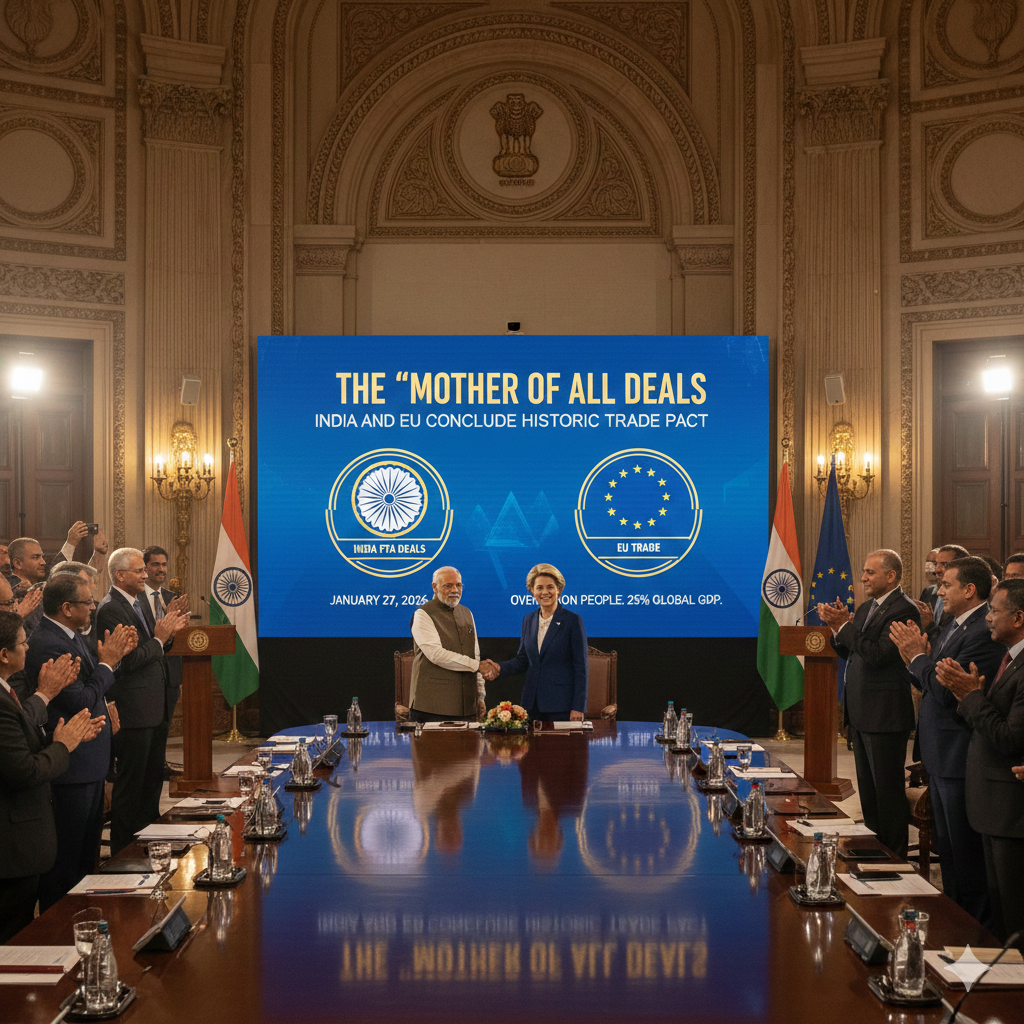
Mother of All Deals: NEW DELHI – In a move that has been hailed as a tectonic shift in the global economic landscape, India and the European Union (EU) officially concluded negotiations for a comprehensive Free Trade Agreement (FTA) today, January 27, 2026.
After nearly two decades of intermittent dialogue that began in 2007, Prime Minister Narendra Modi and European Commission President Ursula von der Leyen announced the breakthrough at the 16th India-EU Summit.
Table of Contents
The “Mother of All Deals”: India and EU Conclude Historic Trade Pact (India’s FTA Deals With EU)
The deal, frequently dubbed the “Mother of All Deals,” creates a free trade zone encompassing over 2 billion people and roughly 25% of the world’s GDP.
Key Takeaways of the Agreement
The pact is designed to dismantle long-standing trade barriers, offering unprecedented market access for both Indian and European businesses.
| Sector | Impact for India | Impact for the EU |
| Goods | 99.5% of Indian exports will enjoy duty-free access to the EU. | Tariffs on 96.6% of EU goods will be reduced or eliminated. |
| Automotive | Increased export of Indian-made components. | India will slash car tariffs from 110% to 10% (under a quota of 250k vehicles). |
| Agriculture | Boost for marine products, fruits, and processed foods. | Massive cuts on wine (150% down to 20-30%) and spirits (40%). |
| Services | Easier mobility for Indian IT and healthcare professionals. | Privileged access to Indian financial and maritime services. |
A Strategic Shield in Turbulent Times
The timing of the deal is no coincidence. As global trade faces headwinds from shifting US trade policies and supply chain disruptions, this FTA serves as a “Strategic Shield.”
“Today, the world’s two largest democratic powers are adding a decisive chapter to their relationship,” PM Modi remarked during the joint press conference at Hyderabad House.
Beyond just commerce, the agreement includes a €500 million EU climate fund to support India’s green transition and a dedicated chapter for Small and Medium Enterprises (SMEs) to ensure the benefits of the deal reach beyond corporate giants.
What Happens Next?
While the negotiations are officially closed, the “legal scrubbing” (the process of finalizing the technical legal language) will take the next 5 to 6 months.
- Formal Signing: Expected by mid-2026.
- Implementation: The deal is slated to come into force by the end of 2026 or early 2027 following ratification by the European Parliament.
How India’s FTA Deals With EU specifically affects a particular sector, like the Indian IT industry or the European automotive market?
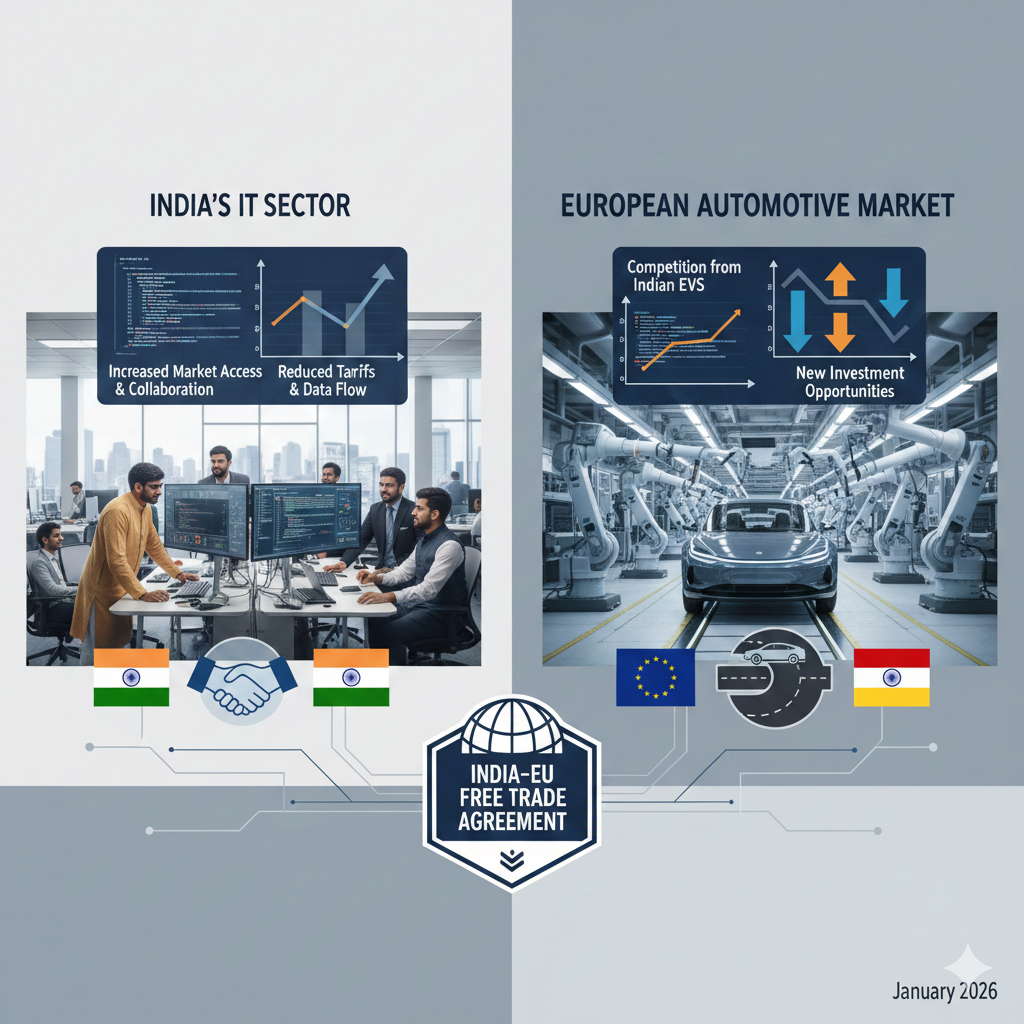
The January 2026 signing of the India-EU Free Trade Agreement (FTA) marks a watershed moment for two specific powerhouses: the Indian IT sector and the European automotive industry. While both gain significant market access, the “fine print” reveals strategic wins for each side.
1. Indian IT & Services: The “Talent Bridge”
For India, the FTA is less about hardware and more about the seamless movement of its greatest export: human capital.
- Mode 4 Mobility (Movement of Professionals): The deal secures ambitious commitments for “Intra-Corporate Transferees” (ICT) and independent professionals. Indian techies will find it significantly easier to obtain short-term work visas in the EU. Crucially, the deal includes working rights for spouses of these transferees—a major sticking point in previous years.
- Access to 144 Sub-sectors: India gained preferential access to 144 EU service sub-sectors, including IT, healthcare, and engineering. This allows Indian firms like TCS, Infosys, and HCL to compete for EU government and private contracts on a more level playing field with local European firms.
- Digital Sovereignty & Data: While the EU pushed for strict GDPR-aligned rules, India secured a framework for “responsible data-sharing” and cooperation on Digital Public Infrastructure (DPI). This allows Indian fintech and identity solutions (like UPI and Aadhaar-style systems) a pathway to interoperability with European digital wallets.
2. European Automotive: The “Premium Reset”
For European carmakers, India has been a “fortress” due to high tariffs. The FTA finally lowers the drawbridge, but with specific speed limits.
- The 110% to 10% Slump: In a massive concession, India will slash import duties on fully built European cars from the current 110% down to 10%.
- The Caveat: This applies to a quota of 250,000 vehicles per year. Beyond this limit, higher “standard” rates still apply.
- Luxury and High-Performance Gain: The biggest winners are brands like Mercedes-Benz, BMW, Audi, and Porsche. A car with a landing cost of ₹1 crore (approx. €110,000), which previously cost ₹3 crore in India, could see its price drop by nearly 40-50% as phased duty cuts take effect.
- The “ICE-only” Start: Interestingly, the initial tariff relief primarily targets Internal Combustion Engine (ICE) vehicles. Electric Vehicles (EVs) are excluded from the duty cuts for the first five years to protect India’s nascent domestic EV ecosystem and players like Tata Motors and Mahindra.
- Component Manufacturing: Tariffs on car parts will be phased out over 5–10 years. This encourages European OEMs to use India as a “China-plus-one” hub, manufacturing components locally for export back to the EU.
Summary Comparison
| Feature | Indian IT Industry | European Automotive |
| Primary Gain | Ease of movement for professionals (Visas). | Drastic tariff reduction (110% → 10%). |
| Strategic Win | Access to EU public procurement/tenders. | Access to the world’s 3rd largest car market. |
| Main Restriction | Alignment with EU data privacy (GDPR). | Quota of 250k units; EVs excluded for 5 years. |
| Long-term Goal | Setting global standards for Digital Trade. | Integrating India into the EU’s global supply chain. |
Winners and Watchouts
- Winners: Indian textile, leather, and gems & jewellery sectors are expected to see an immediate boost. European machinery, chemicals, and luxury car manufacturers will find a much friendlier market in India.
- Watchouts: Domestic Indian dairy and certain agricultural sectors (like rice and sugar) have been kept as “sensitive items” with protected status to prevent market disruption.
You may join my Twitter Account for more news updates, Wordle, and more game answers & hints daily.