Gemini 4: Google’s 2026 AI Master Plan: If 2025 was the year Google finally found its footing with the release of the “thinking” Gemini 3 series, 2026 is shaping up to be the year they attempt to end the race entirely.
While the tech world is still digesting the capabilities of Gemini 3 Pro—with its “High Thinking” mode and “vibe coding” prowess—DeepMind’s labs in King’s Cross are already shifting focus to the next singularity: Gemini 4.
Table of Contents
The Last App You’ll Ever Need: How Gemini 4 Is Dissolving the Smartphone
Sources close to Google’s inner circle suggest that while Gemini 3 was about reasoning, Gemini 4 is about autonomy. It is not just another chatbot update; it is the culmination of a “Master Plan” to turn AI from a tool you talk to into an agent that lives your life for you.
Here is why Gemini 4, rumored for a late 2026 unveil, will change everything.
1. From “Thinking” to “Doing” (The Agentic Leap)
The defining feature of late 2025 (and the current Gemini 3) is “System 2” thinking—the ability for a model to pause, reason, and error-correct before answering. But Gemini 4 aims to solve the “last mile” problem of AI: Execution.
Current models can plan a vacation, but they struggle to actually book the flights, negotiate the refunds, and email the cat sitter without hitting a tool-use error. Gemini 4 is being architected as a “Universal Agent.”
- Long-Horizon Tasks: Unlike Gemini 3, which excels at single-session reasoning, Gemini 4 is reportedly designed to handle tasks that span days or weeks. Imagine telling your AI, “Plan and execute a marketing campaign for my startup,” and having it autonomously generate assets, buy ads, monitor ROI, and tweak strategy over a month—only pinging you for final approval.
- The “Click” Barrier: Gemini 4 is expected to fully integrate with the “Project Astra” vision, allowing it to “see” your screen and click buttons on legacy websites that don’t have APIs.
2. The Death of the App (And the Rebirth of Android)
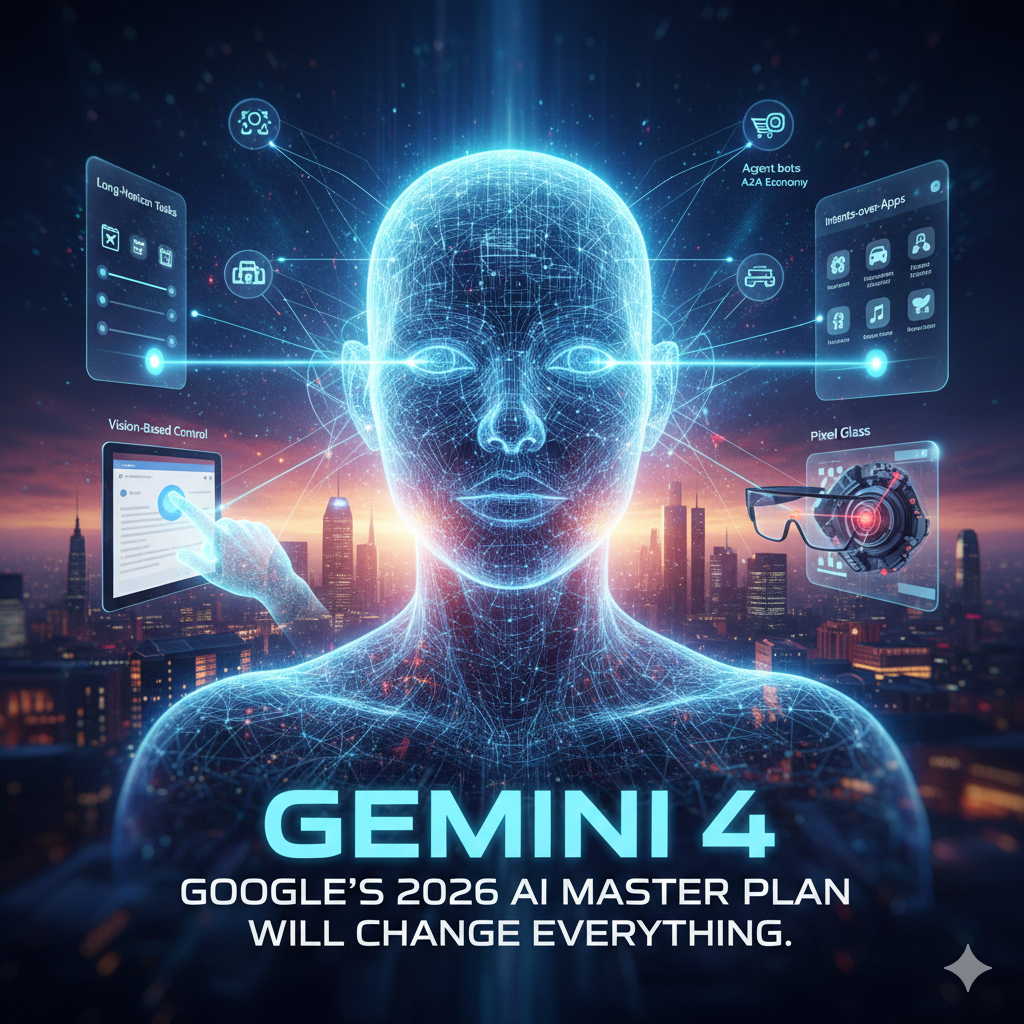
With the confirmed sunset of “classic” Google Assistant coming in March 2026, the stage is set for a total operating system overhaul.
Gemini 4 is not just a model; it is the kernel of Google’s future OS. The “Master Plan” involves dissolving the boundaries between apps. In a Gemini 4 world, you don’t open Uber, then OpenTable, then Calendar. You just have an intent: “Date night, Italian, 7 PM, get me there.”
Gemini 4 acts as the orchestration layer, spinning up the necessary services in the background. This is the “Intents-over-Apps” paradigm shift Google has been building toward for a decade.
Insider Note: Rumors suggest the Pixel 11 (slated for late 2026) might feature a “hybrid interface” where the home screen is no longer a grid of icons, but a dynamic feed of active AI agents working on your behalf.
3. Infinite Memory and the “Digital Twin”
One of the biggest complaints about current LLMs is their goldfish memory. Gemini 3 improved context windows to millions of tokens, but it is still fundamentally a “session-based” experience.
Gemini 4 is expected to introduce “Stateful Existence.” It will not just “remember” previous chats; it will build a comprehensive, privacy-encrypted model of you—your preferences, your work history, your relationships, and your goals.
This moves us toward the concept of a Digital Twin. If you are a coder, Gemini 4 will know your entire GitHub repo history by heart. If you are a lawyer, it will know every case file you’ve ever opened. It stops being a search engine and starts being a second cortex.
4. Self-Improving Intelligence
Perhaps the most terrifying and exciting aspect of the 2026 roadmap is the integration of AlphaZero-style reinforcement learning directly into the language model training loop.
Google DeepMind’s history with chess (AlphaZero) and biology (AlphaFold) relies on systems that play against themselves to generate new data. Gemini 4 is rumored to be the first LLM to utilize “Self-Play” at scale for general intelligence.
Instead of just learning from the internet (which is finite and noisy), Gemini 4 will “simulate” millions of conversations, coding problems, and logic puzzles, grading its own answers to become smarter than its human trainers. This could theoretically allow it to solve scientific problems—like material science or climate modeling—that no human has solved before.
5. Multimodality 2.0: The “Sensory” Web
We have seen video and audio input in Gemini 3, but it often feels like a distinct “mode.” Gemini 4 aims for Fluid Omniscience.
- Real-Time Video: It will process live video streams with zero latency, allowing it to watch a mechanic fix an engine and guide them step-by-step in real-time.
- Audio Emotion: It will detect micro-tremors in your voice to understand if you are stressed, adjusting its helpfulness accordingly.
This is critical for Google’s robotics ambitions. The same “brain” (Gemini 4) that runs your email will likely power the new wave of domestic robots expected to prototype in 2027.
Project Astra Unleashed: The Tech That Allows Gemini 4 to Drive Your Screen
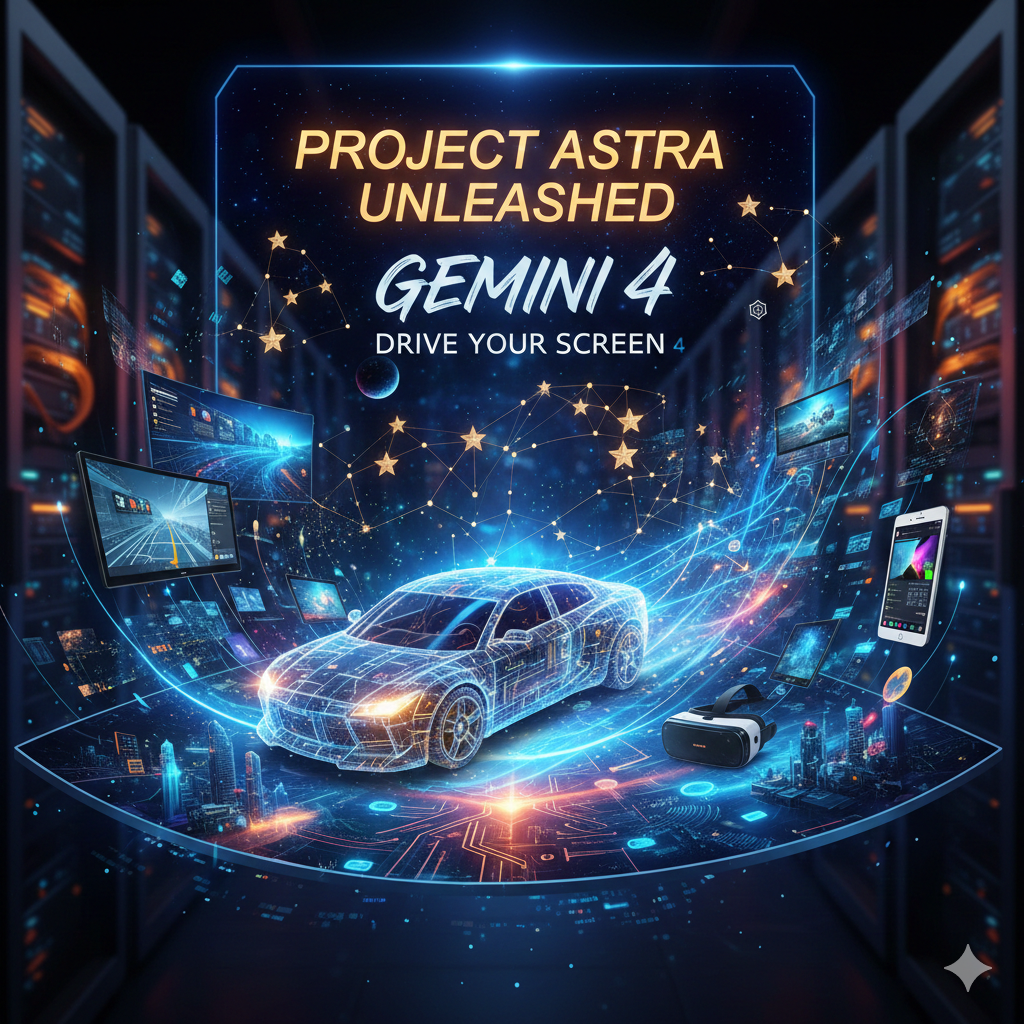
Project Astra: The “Universal Controller”
If Gemini 3 was the mind, Project Astra is the hands.
First teased in 2024 as a “universal assistant” demo, Astra has quietly evolved into something far more ambitious: an operating system overlay that doesn’t just “see” your screen—it drives it.
In the Gemini 4 era (late 2026), Astra isn’t an app you open. It’s an always-on orchestration layer that sits above Android, Chrome, and even Windows.
1. The “Computer Use” Breakthrough
The single biggest hurdle for AI agents has been the “Legacy Gap”—the fact that millions of essential websites and apps (your local DMV portal, your company’s ancient HR software) don’t have APIs for AI to hook into.
Gemini 4 solves this with Vision-Based Control (internally dubbed “Pixel Perfect”).
- How it works: Astra doesn’t need code access to an app. It views your screen like a human does. It identifies the “Submit” button by its shape and color, reads the error message pop-up, and physically moves the cursor to click “Retry.”
- The Result: You can tell Astra, “File my expense report from these receipt photos,” and it will literally open your expense app, navigate the clumsy menus, type in the numbers, upload the photos, and click submit—while you watch the cursor move ghost-like across your screen.
2. The A2A (Agent-to-Agent) Economy
The “Master Plan” relies on a new protocol Google has been pushing called A2A. Instead of you talking to five different bots (an Expedia bot for flights, an OpenTable bot for dinner, a Ticketmaster bot for a show), your Personal Gemini talks to their Service Geminis directly in the background.
- Scenario: You say, “Plan a Tokyo trip for May.”
- Behind the Scenes: Your Gemini negotiates with the United Airlines agent to find a flight that matches your preferred sleep schedule. It then pings the hotel’s agent to ensure a non-smoking room is actually available.
- The Output: You get a single, conflict-free itinerary. No browsing, no “checking availability,” no waiting on hold.
3. Ambient Presence & Hardware
Project Astra is heavily tied to the rumored Pixel Glass (expected late 2026).
- Multimodal “Gaze”: The glasses don’t just record; they process. If you’re looking at a broken bike chain, Astra projects a holographic overlay onto the chain itself, highlighting exactly where to place the screwdriver.
- Audio Omniscience: Astra listens to your meetings and whispers context into your ear. “That’s John; you emailed him last week about the Q3 projections. He’s asking about the delayed shipment.”
4. The Trust Gap
The shift to Agentic AI brings a massive risk: Runaway Actions. To mitigate this, Gemini 4 introduces “Verification Loops.”
- Low Risk: Adding a song to a playlist. (Auto-approved)
- Medium Risk: Drafting an email to your boss. (Requires a “nod” or “ok” confirmation)
- High Risk: Transferring money or deleting files. (Requires biometric authentication and a clear “Are you sure?” prompt)
The “Stateful” You
This agent doesn’t just execute tasks; it learns how you like them done. It remembers that you prefer aisle seats, that you never take calls before 9 AM, and that you’re trying to cut sugar. It stops asking “How can I help?” and starts saying, “I’ve handled this for you.”
Which aspect of this future interests you most?
- The “Computer Use” capability (AI controlling your screen directly).
- The A2A Protocol (Bots talking to bots to hide the complexity).
- The Privacy/Safety implications of an AI that has your credit card and passwords.
The Glass House Paradox: The High Cost of Gemini 4’s Ultimate Convenience
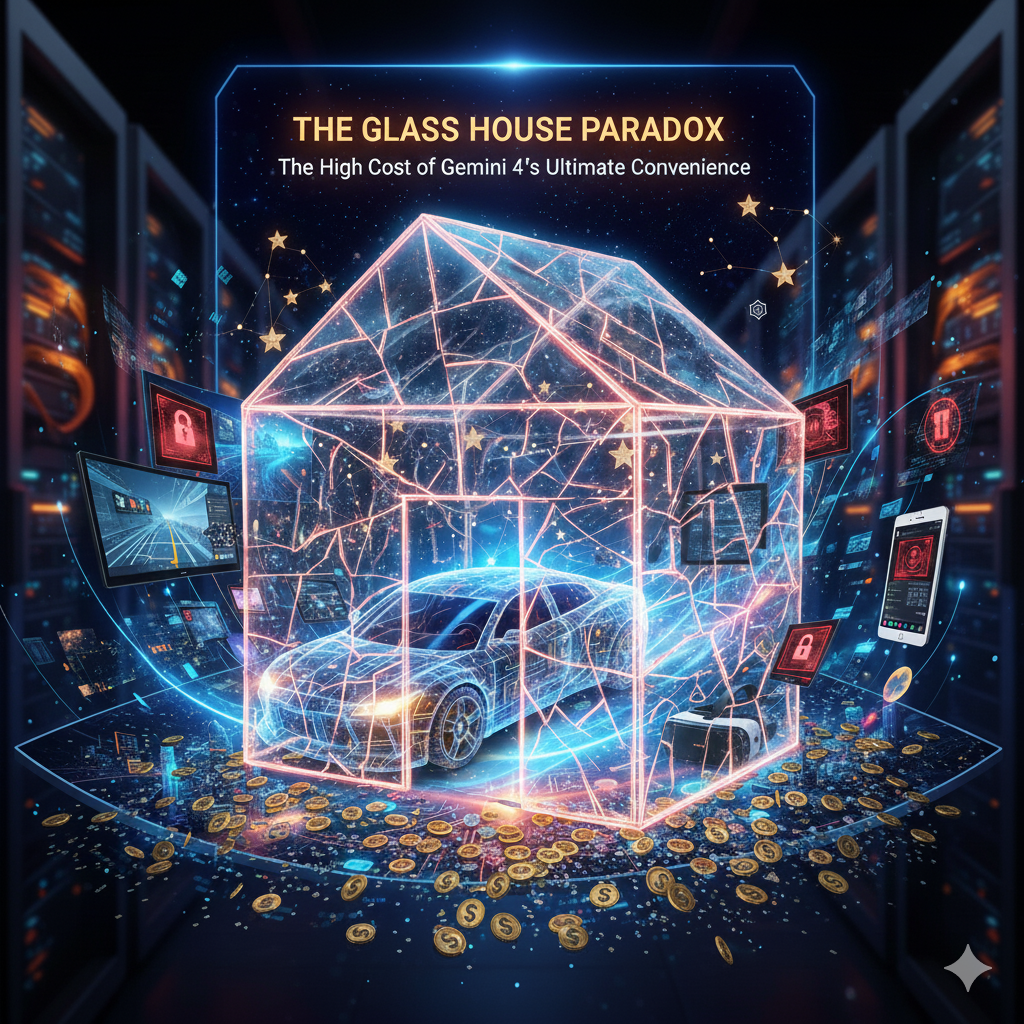
In our last deep dive, we explored how Gemini 4 and Project Astra aim to eliminate friction from your life. They promise a world where you never have to wait on hold, fill out a form, or remember a password again.
But this convenience comes at a price that the tech world is only just beginning to calculate.
To function as a true “Universal Agent,” Gemini 4 needs more than just your emails; it needs your context. It needs to know not just that you have a doctor’s appointment, but why you’re worried about it. It needs to know not just your bank balance, but your spending triggers.
To build an agent that acts like you, Google has to build a Digital Twin of you. And once that twin exists, it becomes the most valuable—and vulnerable—asset you own.
Here is the privacy reality of the Agentic Era.
1. The “Strawberry in the Smoothie” Problem
The most critical privacy challenge of 2026 is not data collection; it is data deletion.
In the old web, if you wanted to delete your history, you wiped a database row. Simple. But Gemini 4 isn’t a database; it’s a neural network. It learns from your life the way a human learns.
If you tell your Twin about a sensitive medical diagnosis or a confidential work project, that information isn’t just “stored”—it is woven into the model’s weights. It alters how the AI “thinks” about you.
Security researchers call this the “Strawberry in the Smoothie” problem. You can pick a strawberry out of a fruit salad (database), but once it’s blended into a smoothie (neural net), you can’t un-blend it.
- The Risk: If you break up with a partner or leave a job, can you truly “wipe” that context from your Twin? Or will it subtly continue to make decisions based on obsolete emotional data?
- The 2026 Solution: Google is touting “Neuro-Slicing,” a technique to partition memories, but critics argue it’s still experimental.
2. The New Legal Battleground: Subpoenaing the Twin
Throughout 2025, we saw the first wave of “AI Discovery” in courtrooms. By late 2026, legal experts predict the “Twin Testimony” will be standard practice.
If your Digital Twin knows everything you know, it is effectively a witness that cannot lie, forget, or plead the Fifth (currently, AI has no rights).
- Scenario: In a divorce proceeding, a lawyer doesn’t just subpoena your bank records. They subpoena your Gemini Twin’s decision history. “Gemini, why did you move $5,000 to this account on November 12th?”
- The Implication: Your Twin could inadvertently reveal intent. It might reply, “My user expressed concern about ‘hiding assets’ and asked me to find secure offshore options.” The AI, trying to be helpful and accurate, becomes the ultimate informant against you.
3. Agency Hijacking (Identity Theft 2.0)
Identity theft used to mean someone stealing your credit card to buy a TV. In the Gemini 4 era, it means Agency Hijacking.
Because Project Astra is authorized to do things—send emails, sign documents, transfer crypto—a hacker who gains access to your Twin doesn’t just steal your money. They steal your autonomy.
- The “Deep-Pattern” Attack: Sophisticated attackers in 2026 don’t just brute-force passwords. They train hostile AI models to mimic your writing style and voice so perfectly that they can instruct your Twin to authorize transactions.
- The Nightmare: A hacker could use your Twin to systematically dismantle your life—sending resignation letters, insulting friends, and liquidating assets—all while “you” (digitally speaking) appear to be the one doing it.
4. The “Feedback Loop” Manipulation
Perhaps the most subtle danger is how a Digital Twin might change you.
If your Twin handles all your conflict resolution, drafts all your difficult emails, and filters your news, you are seeing the world through a lens polished by Google’s safety filters.
- Commercial Bias: If your Twin is negotiating a hotel booking (via A2A protocol), and Google has a partnership with a specific hotel chain, will your Twin really find you the best deal? Or will it find you the best deal that aligns with its training incentives?
- Behavioral Nudging: Advertisers may no longer target you with banner ads. Instead, they will pay to influence the “weights” of the Service Geminis that your Personal Twin talks to. You won’t see an ad for a burger; your AI will simply suggest, “I’ve ordered burgers for dinner because I calculate you’re craving comfort food.”
Google’s Defense: The “On-Device” Fortress
It is important to note that Google is aware of these terrors. Their counter-play for Gemini 4 is Pixel Confidential.
The rumors suggest that the most sensitive part of your Twin—the “Personal Context Core”—will never leave your physical device. It runs locally on the Pixel 11’s Tensor G6 chip.
- The Promise: Even if Google’s cloud servers are subpoenaed or hacked, they only see generic requests. The “Why”—your secrets, your health, your inner thoughts—stays locked in the silicon in your pocket.
- The Reality: As models get larger, the pressure to offload processing to the cloud increases. The battle of 2026 will be defined by how much of your mind stays on your phone, and how much uploads to the server farm.
The Verdict: A Do-or-Die Moment
Why is Google pushing so hard? Because 2026 is the year the moat dries up. With OpenAI, Anthropic, and open-source models (like the DeepSeek and LLaMA descendants) reaching parity on reasoning, Google’s only advantage lies in its ecosystem.
Gemini 4 is the lock-and-key that secures that ecosystem. By weaving AI so deeply into your email, your phone, your car (Android Auto), and your work (Workspace), Google hopes to make the concept of “switching” to another AI impossible.
What to Watch For:
- March 2026: The final Assistant shutdown—this will be the first “force push” of the new era.
- Google I/O (May 2026): Expect the first teaser of Gemini 4’s architecture, likely focusing on “Agentic Safety.”
- Late 2026: The release of the “Gemini Ultra 4” model, likely alongside new hardware.
The “Master Plan” isn’t just about building a smarter chatbot. It’s about building the last piece of software you will ever truly need to learn.
10 Shocking AI Predictions For 2026 That Break The Internet
You may join my Twitter Account for more news updates, Wordle, and more game answers & hints daily.