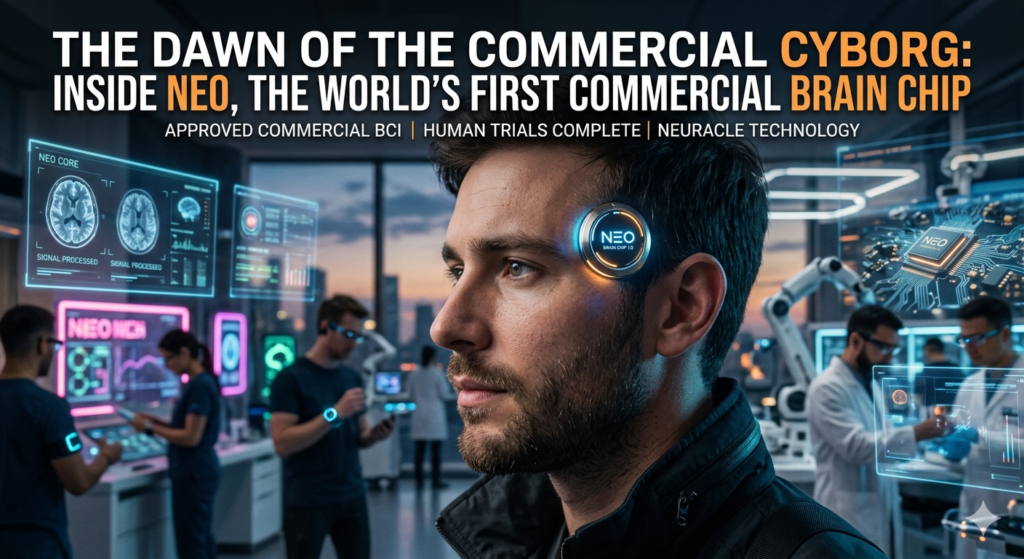
Inside NEO, the World’s First Commercial Brain Chip: For years, the race to merge human consciousness with artificial intelligence felt like a private playground for Silicon Valley billionaires. We watched Elon Musk’s Neuralink stream videos of patients playing chess with their minds, assuming the first widely available brain-computer interface (BCI) would bear an American tech logo.
Instead, the geopolitical and technological paradigm has shifted. China’s National Medical Products Administration granted official commercial approval to NEO, a coin-sized BCI developed by Beijing’s Tsinghua University and Shanghai-based startup Neuracle Technology.
Table of Contents
Inside NEO, the World’s First Commercial Brain Chip
NEO is the world’s first invasive brain chip to clear clinical trials and legally enter the mass consumer medical market. This marks a massive transition: BCIs are no longer experimental lab procedures—they are regulated commercial products.
How NEO Works
NEO (short for Neo-Brain) is a surgically implanted device roughly the size of a small coin. It is specifically designed to interpret the brain’s electrical intent and translate it into digital commands.
In its current commercial application, NEO targets patients aged 18 to 60 suffering from severe paralysis and spinal cord injuries. During a 90-minute surgical procedure, the device is embedded into the skull. It captures neural signals in real-time, sending them wirelessly to a nearby computer or specialized prosthetic.
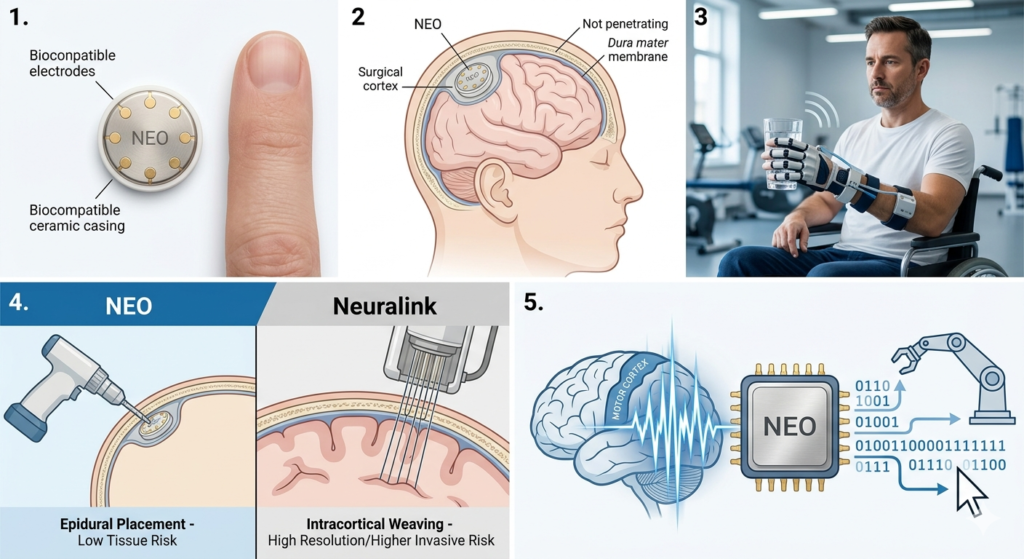
In clinical trials involving dozens of paralyzed patients, NEO successfully allowed individuals to control a pneumatic robotic glove using only their thoughts. By simply thinking about moving their hands, patients were able to grip objects, hold utensils, and drink water independently.
NEO vs. Neuralink: The Ultimate Tradeoff
While western headlines often frame this as “China beating Elon Musk,” the reality reveals two completely different design philosophies. The divergence between NEO and Neuralink’s N1 chip highlights a classic engineering tradeoff: Invasiveness vs. Signal Clarity.
| Feature | NEO (Neuracle / Tsinghua) | N1 Chip (Neuralink) |
| Surgical Placement | Epidural: Sits on top of the dura mater (the brain’s protective membrane). | Intracortical: Penetrates directly into the cerebral cortex. |
| Insertion Method | Standard neurosurgery; does not pierce brain tissue. | Micron-thin threads woven directly into brain tissue using a proprietary surgical robot. |
| Signal Target | Aggregate cortical activity (broad groups of neurons). | Individual neurons (highly localized data). |
| Medical Risk | Lower: Minimal risk of brain hemorrhaging, glial scarring, or cellular rejection. | Higher: Increased risk of tissue damage or long-term signal degradation as the brain reacts to threads. |
| Signal Resolution | Lower: Like listening to a stadium crowd from the parking lot. Sufficient for broad motor commands. | Higher: Like placing a microphone next to a single person in the stadium. Allows for highly precise control. |
| Regulatory Status | Fully approved for commercial use in China’s state healthcare system. | Authorized strictly for human trials and investigational research (FDA approval pending). |
NEO’s genius lies in its restraint. By placing its eight sensors on top of the dura mater rather than piercing the delicate tissue of the brain, Neuracle dramatically lowered the biological risk profile. This safety-first compromise is precisely why Chinese regulators felt comfortable fast-tracking the device into the public health sector, while Neuralink remains locked in rigid, multi-stage FDA trial pathways.
The Ripple Effect: Impact on Medicine and Tech
The commercialization of NEO represents a monumental fork in the road for both healthcare and technology.
1. Radical Shift in Neurorehabilitation
For medicine, NEO proves that invasive BCIs can safely leave the research laboratory. While it is currently cleared for spinal cord injuries, its underlying technology provides a template for targeted neural modulation. Clinicians are already projecting its use to treat:
- Parkinson’s disease (by overriding motor tremors)
- Epilepsy (by predicting and suppressing seizures)
- Severe treatment-resistant depression and chronic pain
Because NEO has already been integrated into China’s state-backed insurance system, we are about to see the first mass-scale data set on how brain chips perform in the real world over months and years.
2. The Acceleration of “Digital Biology”
On the tech front, NEO is a massive catalyst. BCIs are no longer just a hardware challenge; they are an AI challenge. Devices like NEO generate massive amounts of messy, noisy neural data. To make sense of it, developers are building advanced, low-power machine learning models that can decode brain syntax instantly.
This commercial rollout will likely force Western competitors to accelerate their timelines and pressure global regulators to establish standardized ethical frameworks for neural data.
[Brain Signal Generated] ➔ [NEO Sensor (On Dura Mater)] ➔ [AI Decoding Model] ➔ [Robotic Glove / Digital Cursor]
3. The Dystopian Shadow: Privacy & Security
Of course, moving mind-machine interfaces into the commercial market raises immediate red flags. Security experts warn that if a device can transmit your motor intent outward, the system architecture could theoretically be vulnerable to exploitation.
Unlike a hacked smartphone, a compromised BCI carries dystopian stakes: the potential for bad actors to intercept sensitive neural data, alter cognitive focus, or corrupt the digital commands being sent to assistive prosthetics.
Elon Musk Vs China: NEO Brain Chip को मिली मंजूरी, क्या Neuralink पीछे रह गई?
The Verdict
The launch of NEO changes everything. By choosing a less-invasive, highly practical design, its creators bypassed the biological hurdles that continue to slow down intracortical chips. NEO might not offer the ultra-high fidelity of Neuralink’s neuron-weaving threads, but it possesses the ultimate competitive advantage: it is available to patients right now.
The era of mainstream neurotechnology hasn’t just arrived—it has officially hit the market.
You can learn more about how this technology functions by watching this NEO Brain Chip Overview, which breaks down the mechanics of the implant and details its competitive advantages over Western alternatives like Neuralink.
Varya: This New Indian AI Tool Generates Cinematic Videos for the Price of a Cutting Chai
You may join my Twitter Account for more news updates, Wordle, and more game answers & hints daily.