Smart Glasses vs. Smart Rings: We are witnessing a quiet, wearable revolution. The reign of the wrist is ending, but what comes next? As the market shifts towards “Calm Technology”—devices designed to blend seamlessly into our lives without the constant buzz and glare—the race to succeed the smartwatch has heated up between two powerful contenders: Smart Rings and Smart Glasses.
While smartwatches like the Apple Watch have dominated for a decade, user fatigue is real. A 2025 consumer report indicated that 34% of long-term smartwatch users cited “notification anxiety” and “screen bulk” as reasons they are looking for a change.
Table of Contents
Smart Glasses vs. Smart Rings: Which One Should Replace Your Watch?
If you are looking to simplify your life, declutter your wrist, and improve your relationship with technology, you are likely looking at the Samsung Galaxy Ring or the Meta Ray-Ban Smart Glasses. But which one is the true successor to your watch?
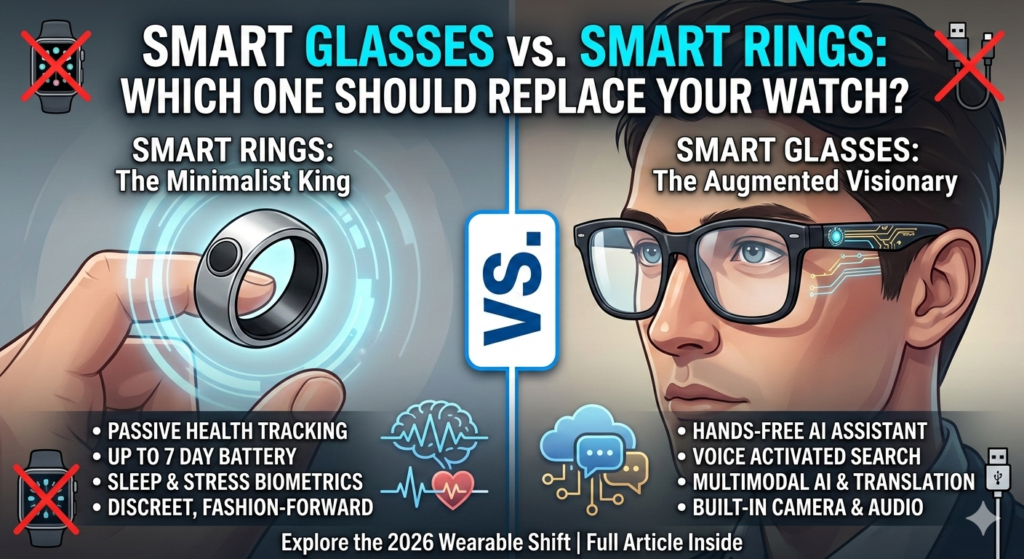
Let’s break down the ultimate face-off of the post-watch era.
🦾 Contender 1: The Smart Ring (The Minimalist King)
The smart ring is the definition of “quiet tech.” Leading devices like the Samsung Galaxy Ring and the Oura Ring Gen4 (launched in 2025) are designed for those who want to be connected without a glowing rectangle attached to their body.
Key Strength: Passive, 24/7 Intelligence
The core advantage of the ring is its unobtrusive, biometric tracking. Unlike a watch, which often needs charging every 24–48 hours, a smart ring can stay on your finger for up to 7 days on a single charge. This makes it a vastly superior device for 24/7 sleep tracking and health monitoring.
- The Killer Feature: Contextual, 24/7 Autonomy. These devices have refined their health metrics. They are no longer just counting steps; they provide highly accurate cardiovascular data and wellness “readiness” scores based on continuous reading.
- Best For: Health obsessives, minimalists, and those who prioritize long battery life.
👓 Contender 2: Smart Glasses (The Augmented Visionary)
While rings prioritize silence and data, smart glasses like the Meta Ray-Ban series are designed for augmented interaction. They don’t just measure you; they actively change how you interact with your environment.
Key Strength: An AI Assistant, Right in Front of You
Smart glasses provide an immediate, hands-free bridge to AI. Their primary function is not to replace your health tracker, but to augment your reality with information. They merge a high-quality camera, powerful microphone, and open-ear speakers.
- The Killer Feature: AI-Powered Contextual Search. This is the game-changer. You can look at a sign in a foreign language and ask, “Hey Meta, translate that sign,” and hear the result immediately. You can view a recipe on your counter and say, “Tell me the next ingredient.” It’s information without the phone-reach.
- Best For: Creator-class, frequent travelers, hands-on workers, and those who prioritize quick information access.
The Face-Off: Ring vs. Glasses
1. Notifications and Interaction
- Smart Ring: Total silence. There is no screen. Rings communicate purely through your phone, or sometimes with a subtle haptic vibration. If you want a digital detox, this is it.
- Smart Glasses: Auditory and visual. Glasses can read you text messages and provide visual information (in the case of display-equipped glasses, though standard Meta Ray-Bans only offer auditory feedback).
2. Health and Biometric Tracking
- Smart Ring (The Clear Winner): This is what rings were built for. Their continuous, passive monitoring is more reliable than a watch (which moves on the wrist) or glasses (which are taken off frequently).
- Smart Glasses: Their tracking is minimal (often only activity duration). They are not designed for heart rate monitoring or sleep analysis.
3. Battery Life and Practicality
- Smart Ring (The Winner): 5–7 days. It stays on your body. You can shower, swim, and sleep with it.
- Smart Glasses: 4–6 hours of heavy use (recording, AI). They must be placed in their charging case daily.
4. Aesthetics and “Fashion Vibe”
- Smart Ring: Discreet. It’s jewelry. A gold, silver, or black ring is classic.
- Smart Glasses: A statement piece. The Meta Ray-Bans look like iconic Wayfarers, but you are still wearing glasses. For non-prescription wearers, this is a conscious stylistic choice.
Supported Data: How the Shift is Happening
The numbers back up this wearable diversification. For years, the market was simply: Smartwatch (70%) + “Other” (30%). In 2026, the data shows the wrist is breaking up.
Wearable Tech Market Share Shift (Predicted US Data, 2024 vs. 2026):
| Wearable Category | 2024 Market Share | 2026 Projected Share | Growth Drivers |
| Smartwatch | 71% | 45% | Market saturation; notification fatigue. |
| Smart Ring | 8% | 22% | Discretion, 24/7 battery life, Oura/Samsung competition. |
| Smart Glasses | 5% | 18% | AI integration (Multimodal AI like Llama 4), Creator economy. |
| Other (Hearables, etc.) | 16% | 15% | Incremental improvements. |
This table illustrates the aggressive 3x growth expected for both Smart Rings and Smart Glasses as the general “Smartwatch” category begins to fragment.
User Reactions: Are You “Silence” or “Augmentation”?
The shift is as psychological as it is physical. We asked real users who have attempted the switch:
The Minimalist’s Take (Team Ring)
“The Apple Watch made me feel like an indentured servant to my wrist buzzes. I traded it for an Oura Gen4 and a classic metal watch. I get my data, my phone stays in my pocket, and I actually enjoy checking the time on a ‘dumb’ watch again. Total freedom.”
— Sarah, 29, Data Analyst, Boston
The Future-Forward View (Team Glasses)
“I thought I’d hate walking around in glasses, but my Meta Ray-Bans are indispensable. I use them for work—recording instructions hands-free—and the real-time translation while I travel is magical. My health data isn’t everything; immediate context is.”
— David, 34, UX Designer, San Francisco
The Verdict: Which One Succeeds Your Watch?
There is no single answer; it depends entirely on your primary goal.
You should choose the Smart Ring IF:
- You want a minimalist digital detox.
- Your priority is 24/7, detailed health metrics (especially sleep tracking).
- You are tired of charging devices daily.
You should choose the Smart Glasses IF:
- You want hands-free access to a powerful AI assistant.
- You frequently create content, travel, or need on-the-go information.
- You don’t mind a device you only wear during the day.
The era of one dominant wrist device is ending. 2026 isn’t about finding the single best device—it’s about finding the best device for your specific relationship with technology.
Meta’s New AI Glasses: A Step into the Mind-Controlled Future
10+ Most Useful Futuristic Gadgets You Will Likely Want to Use by 2026
You may join my Twitter Account for more news updates, Wordle, and more game answers & hints daily.