Nvidia’s RTX Vision TV: In 2026, the home entertainment landscape is being redrawn. While Samsung and Xiaomi have long dominated the “Smart TV” market with iterative upgrades, Nvidia has reportedly shifted from being a component supplier to a direct hardware disruptor.
Table of Contents
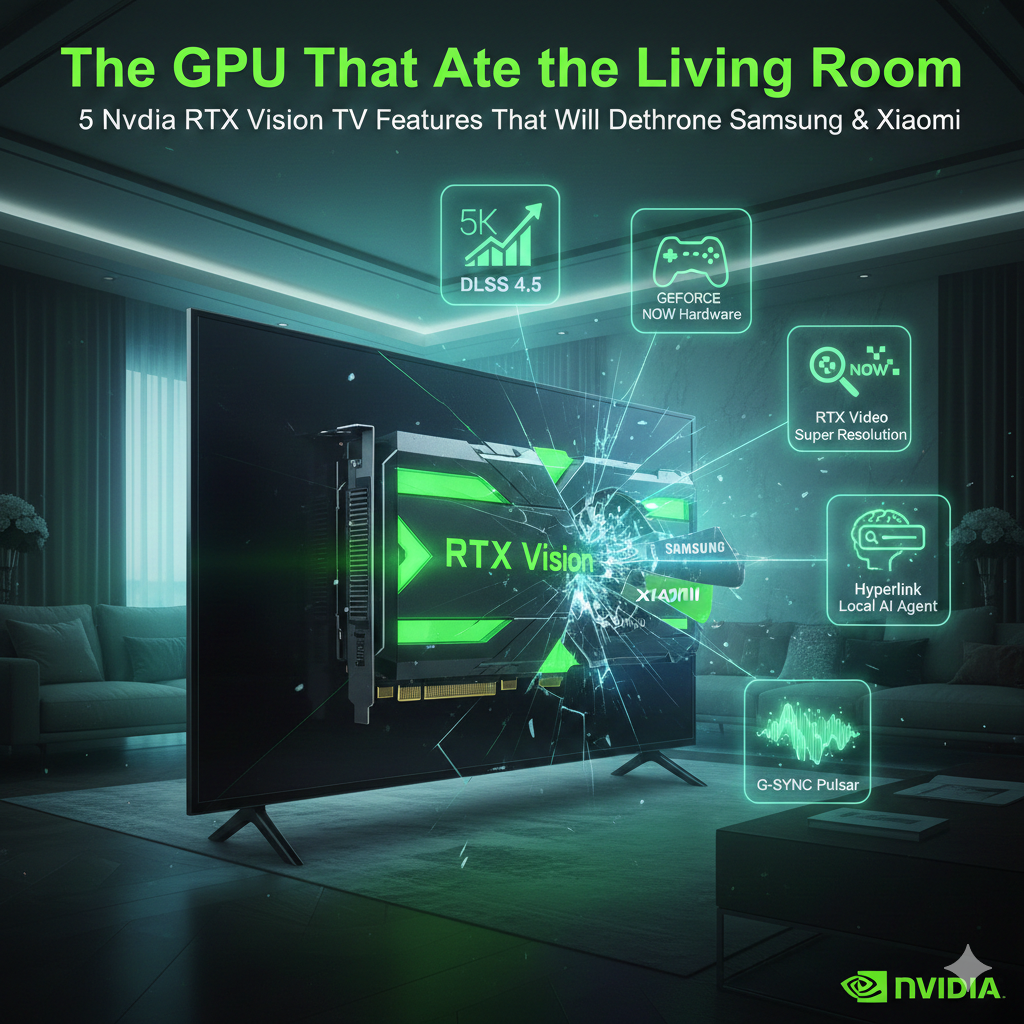
5 Nvidia’s RTX Vision TV Features That Will Dethrone Samsung & Xiaomi
The 2026 Nvidia “RTX Vision TV“ isn’t just a screen—it’s a localized AI powerhouse that leverages the Blackwell architecture to do what traditional TVs simply can’t. Here are the five features that are set to leave the current market leaders in the rearview mirror.
1. DLSS 4.5: The End of Native 4K Anxiety
Samsung’s “AI Upscaling” has always been about sharpening edges. Nvidia’s DLSS 4.5 (Deep Learning Super Sampling) changes the game by using Dynamic Multi-Frame Generation.
- The Impact: It doesn’t just upscale; it reconstructs frames.
- The Edge: While Xiaomi struggles to maintain 60fps on 4K content, the RTX Vision TV can take a 1080p stream and transform it into a 5K, 120Hz masterpiece with zero artifacts, effectively making “low-quality” content extinct.
2. Integrated “GeForce NOW” Hardware
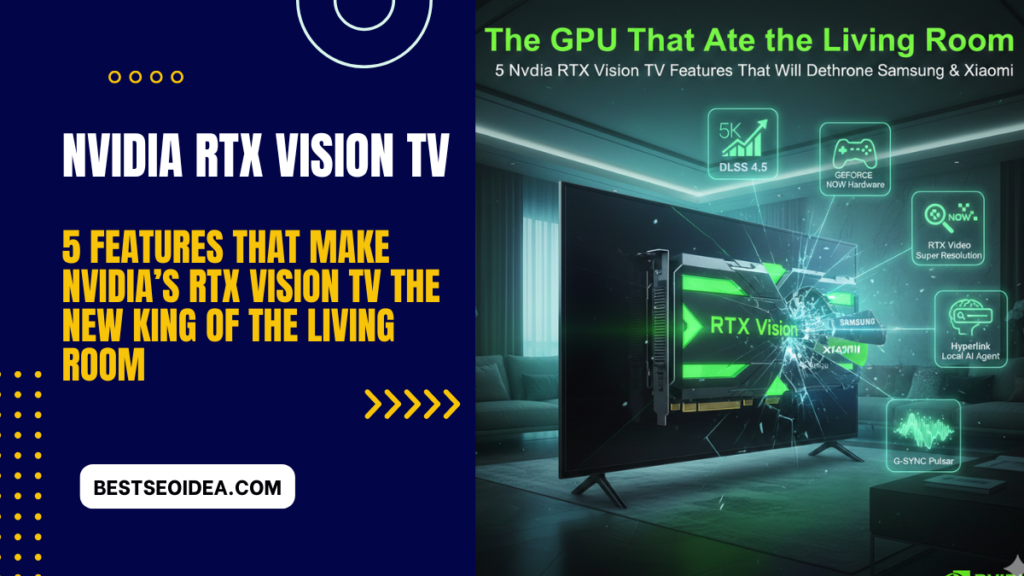
For years, Samsung and Xiaomi TVs have offered cloud gaming “apps.” Nvidia is integrating the RTX 50-series silicon directly into the TV’s logic board.
- Local Latency: By bypassing the standard Android TV/Tizen processing layers, the RTX Vision TV offers “Reflex” ultra-low latency.
- The Edge: You no longer need a console. The TV itself performs like a high-end PC, offering native path-tracing and ray-reconstruction that Samsung’s Tizen OS processors simply don’t have the TFLOPs to match.
3. RTX Video Super Resolution (VSR) for Every App
Samsung and Xiaomi are at the mercy of the bitrates provided by Netflix or YouTube. Nvidia’s RTX VSR works at the hardware level to clean up streaming compression.
- AI Noise Removal: It uses Tensor cores to identify and remove blocky “macro-blocking” and ringing artifacts in real-time.
- The Edge: Even a low-bitrate live sports stream on the RTX Vision TV looks like a high-bitrate Blu-ray, a feat traditional TV processors can’t replicate without significant “smearing.”
4. “Hyperlink” Local AI Agent
The biggest weakness of current smart TVs is the clunky UI and “dumb” voice assistants. The RTX Vision TV introduces Hyperlink, a local search agent.
- Privacy-First AI: Unlike Xiaomi’s cloud-dependent assistants, Hyperlink processes everything locally on the TV’s internal GPU.
- Natural Context: You can ask, “Find that movie I was watching last Tuesday where the guy wears a red hat,” and it will index your watch history and local files to find it in seconds.
5. G-SYNC Pulsar: The Death of Motion Blur
Samsung’s “Motion Xcelerator” and Xiaomi’s “Vivid Picture Engine” often rely on “Black Frame Insertion,” which dims the screen. Nvidia’s G-SYNC Pulsar technology solves this differently.
- Strobe Synchronization: It perfectly syncs the backlight strobing with the pixel transition, maintaining 1000+ nits of brightness while delivering over 4x the effective motion clarity.
- The Edge: In fast-moving action or gaming, the RTX Vision TV remains crystal clear while competitors suffer from “ghosting” or dimmed brightness.
2026 Nvidia “RTX Vision TV”: 5 Features That Will Destroy Samsung & Xiaomi
The Verdict: A New King in Town?
Samsung and Xiaomi have built their empires on display panels, but Nvidia is building theirs on intelligence. The RTX Vision TV represents a shift where the “brain” of the TV is more important than the glass itself. If these features hit the market as expected, the “Smart TV” era is over—the “AI TV” era has begun.
Nvidia’s First AI NeoPhone Will END the iPhone Era?
You may join my Twitter Account for more news updates, Wordle, and more game answers & hints daily.