AI in Gaming: For decades, Artificial Intelligence in gaming was largely synonymous with predictable enemy patterns, rudimentary pathfinding, and the occasional boss battle scripted to a fault. Today, the landscape is dramatically different. From generating sprawling, unique worlds to crafting NPCs with uncanny emotional depth.
Table of Contents
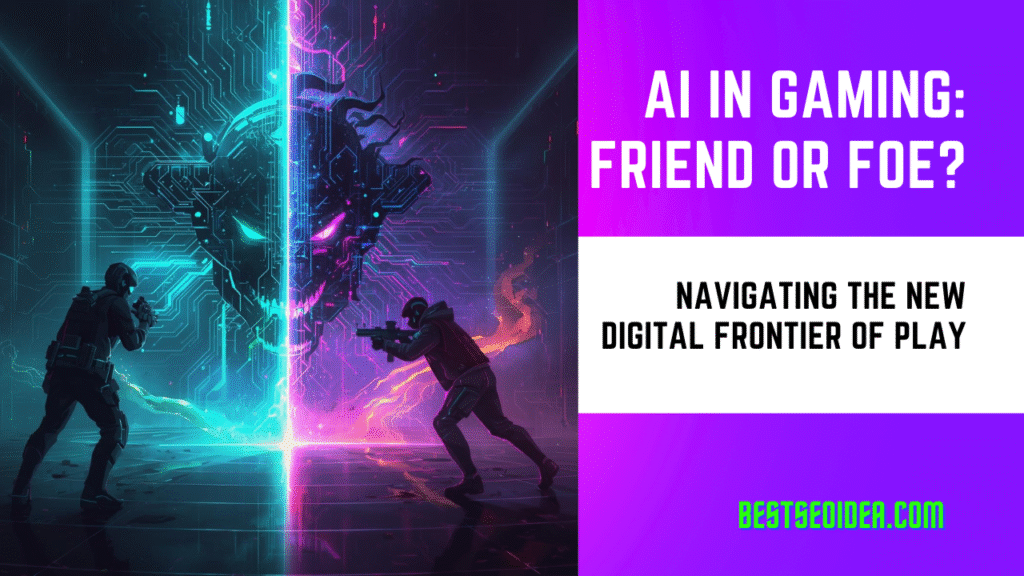
AI in Gaming: Friend or Foe? Navigating the Digital Frontier of Play
AI is no longer just a feature; it’s rapidly becoming the very fabric of our digital playgrounds. But as AI’s capabilities burgeon, we’re left to ponder: Is this powerful new tool a benevolent friend, enriching our experiences beyond imagination, or a potential foe, threatening the very essence of human creativity and control?
The AI Renaissance: Crafting Worlds, Weaving Narratives
The most visible impact of AI is perhaps in the realm of content generation. Imagine a game world that is truly infinite, where every forest, mountain, and city block is uniquely generated on the fly, not by a human designer, but by an AI. This isn’t science fiction; games like No Man’s Sky already employ procedural generation, an early form of AI, to create vast, diverse universes. The next evolution promises even more.
Advanced AI models are now capable of generating not just landscapes, but complex quests, believable lore, and even adapting story branches based on player choices. This could lead to truly personalized narratives, where no two players experience the exact same story beats. Think of an AI dungeon master, learning your preferences, weaknesses, and playstyle, then weaving a bespoke adventure just for you. The potential for replayability and immersion is staggering.
Then there are the Non-Player Characters (NPCs). Gone are the days of static shopkeepers repeating the same three lines of dialogue. Modern AI is breathing life into NPCs, granting them more realistic behaviors, dynamic responses, and even emergent personalities. Imagine an NPC who remembers your past interactions, reacts to your reputation within the game world, and even develops rudimentary “emotions” based on the unfolding narrative. This elevates NPCs from mere quest-givers to genuine inhabitants of the game world, making our interactions far more meaningful.
Furthermore, AI is revolutionizing game development itself. Tools powered by AI can automate tedious tasks like texture creation, animation rigging, and even bug testing, freeing up human developers to focus on higher-level design and creative vision. This could accelerate development cycles, lower costs, and ultimately lead to a greater diversity of games.
The Shadow of the Machine: Ethical Quagmires and Existential Questions
While the benefits are undeniable, the rapid integration of AI also casts a long shadow, raising significant ethical and philosophical questions.
One major concern revolves around authenticity and artistic integrity. If AI can generate entire game worlds and storylines, what becomes of the human artist’s unique voice and vision? Will games become generic amalgamations of algorithms, lacking the soul and intention that only human creativity can imbue? There’s a fear that AI, while efficient, might ultimately flatten the artistic peaks, leading to a deluge of technically proficient but emotionally hollow experiences.
Another area of debate is the ethical treatment of AI itself, particularly as NPCs become more sophisticated. If an AI can genuinely express distress or joy, what are our responsibilities towards it? While they are not sentient in the human sense, the line blurs as AI becomes more convincing. This touches on philosophical questions of consciousness and what it means to “exist” within a digital realm.
There’s also the potential for unintended consequences in game balance and design. An AI capable of learning and adapting could, in theory, create scenarios that are unfairly difficult or exploit player psychology in ways that feel manipulative rather than challenging. The “fun” of a game often lies in overcoming well-designed obstacles, not in being constantly outsmarted by an omnipresent digital entity.
Finally, the issue of control looms large. As AI systems become more autonomous and complex, understanding their decision-making processes can become opaque. If an AI generates content or dictates game progression in ways that are unexpected or undesirable, debugging and course-correction could become incredibly challenging.
The Personalized Playbook: A Dynamic Future
Despite these concerns, the promise of a more personalized and dynamic gaming experience remains incredibly alluring. Imagine:
- Adaptive Difficulty: AI that truly understands your skill level and adjusts challenges in real-time, preventing frustration for newcomers and offering genuine tests for veterans.
- Dynamic Storytelling: Quests and narratives that shift based on your in-game actions, morality, and even how you interact with specific NPCs.
- Procedurally Generated Replayability: Games that offer endless new content, ensuring that every playthrough feels fresh and unique.
- AI-Driven Mentors & Companions: Intelligent allies who truly assist, learn alongside you, and offer strategic advice tailored to your playstyle.
The ultimate vision is a game that feels alive, constantly evolving and responding to the player in a deeply personal way. AI isn’t just about making things easier; it’s about making them richer, more complex, and more tailored to individual tastes.
Conclusion: A Symbiotic Relationship
Ultimately, the question of AI in gaming being “friend or foe” isn’t a binary one. Like any powerful tool, its impact depends entirely on how we wield it. The optimal future likely lies in a symbiotic relationship: AI as a powerful assistant, augmenting human creativity rather than replacing it.
Game developers, players, and ethicists must work together to establish guidelines and best practices. We need to ensure that AI enhances our play, fuels our imaginations, and offers experiences previously unattainable, without sacrificing the artistic integrity, ethical considerations, or the sheer human joy that defines gaming.
The digital frontier is vast and exciting, and with careful navigation, AI can indeed be our greatest ally in exploring its infinite possibilities.
You may join my Twitter Account for more news updates, Wordle, and more game answers and hints daily.
Cam Skattebo’s Case for More Carries: A Week 3 Turning Point Against the Chiefs