Deal or No Deal is a high-stakes, suspenseful game show where a contestant gambles against a mysterious figure known only as “The Banker.” Originating in the Netherlands, the American version, hosted by Howie Mandel, became a pop culture phenomenon when it premiered on NBC in 2005.
The game’s success lies in its simple yet deeply psychological format, which requires no general knowledge, only an ability to manage risk and emotion.
Table of Contents
How the Game “Deal or No Deal” Is Played
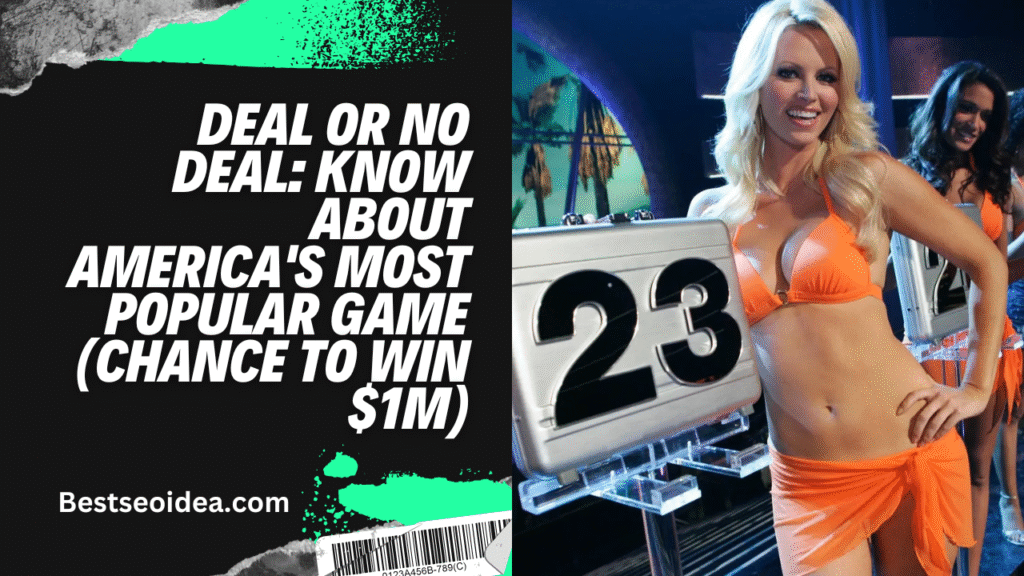
The game begins with 26 briefcases, each containing a different monetary value ranging from a single cent to a grand prize of $1,000,000. The values are known, but their location inside the cases is a secret. A single contestant is chosen to play and selects one case to be their own, placing it on a pedestal to remain unopened until the very end.
The game then proceeds in a series of rounds. In each round, the contestant chooses a number of the remaining cases to be opened. As each case is opened, its monetary value is revealed and eliminated from the game board, which is a large display showing all possible prize amounts. The goal is to eliminate the small values, leaving the large ones on the board to increase the value of the contestant’s own case.
After each round, “The Banker” makes a phone call to the host and offers the contestant a cash prize to quit the game. This offer is based on the average value of the remaining prizes on the board, but it is typically a lowball offer in the early rounds. The contestant must then make a critical decision: “Deal or No Deal?”
- Deal: The contestant accepts the Banker’s offer and the game ends.
- No Deal: The contestant rejects the offer and continues to the next round, hoping to eliminate more small values and get a better offer.
The rounds continue, with the number of cases to be opened decreasing as the game progresses. The Banker’s offers usually increase as the game narrows down to higher-value cases. The final round occurs when only two cases are left—the contestant’s and one other.
If the contestant rejects the final offer, they have the option to either keep their original case or swap it for the last remaining one. They then win the amount inside their chosen case.
The Psychology of the Game
What makes Deal or No Deal so compelling is its focus on human psychology and risk-taking. Contestants are often influenced by emotions, superstition, and the advice of their friends and family in the audience.
They might feel a “lucky” streak or become superstitious about certain case numbers. The show is less about mathematical probability and more about the contestant’s personal threshold for risk.
The game creates a powerful tension between the security of the Banker’s offer and the lure of a potentially life-changing jackpot. A contestant who has eliminated several small-value cases might feel confident in continuing, but a single bad pick that reveals a high-value case can instantly reduce the Banker’s next offer, leading to immense regret.
Similarly, a contestant with a great board may be tempted to keep playing for an even bigger offer, only to eventually win a small amount. This constant push and pull between greed and fear is the central drama of the show.
Legacy and Impact
Deal or No Deal was a major success for NBC, particularly in its early seasons, with viewership sometimes exceeding 18 million. Its popularity led to several spinoffs and international versions, as well as a variety of tie-in merchandise, including board games, video games, and even lottery tickets.
The show’s format has also become a subject of academic study, with researchers using it to analyze decision-making under uncertainty and risky choice behavior. The game’s enduring appeal lies in its ability to turn a simple game of chance into a captivating showcase of human emotion and the drama of high-stakes gambling.
The following video shows some of the highlights from the game show’s USA version.
You may join my Twitter Account for more news updates, Wordle, and more games answers and hints daily.
High Stakes Marathon | Ultimate Game Show Binge | Deal or No Deal USA
The Future of Rest: How Eight Sleep Delivers an Enjoyable, Peaceful Sleep