Best Coke Types: Coke is the solid, carbon-rich residue derived from the destructive distillation of coal (heating coking coal in the absence of oxygen to drive off volatile gases and moisture). While raw coal contains significant impurities, moisture, and volatile matter, coke burns hotter, produces negligible smoke, and delivers high structural strength, making it vital for metallurgical processes, industrial boilers, and domestic heating.
The properties of coke—such as carbon content, ash percentage, burning power, and price—vary significantly depending on the type of coal used and the manufacturing process.
Table of Contents
1. Primary Types of Coke: Key Characteristics
| Coke Type | Fixed Carbon Content | Ash Content | Burning Power (Calorific Value) | Approximate Price (Per Tonne)* |
| Hard Coke / Metallurgical Coke | 80% – 88%+ | 10% – 16% | Very High (~7,000–7,500 kcal/kg) | ₹18,000 – ₹30,000 |
| Low Ash Metallurgical (LAM) Coke | 85% – 90%+ | < 10% (5% – 9%) | Extremely High (>7,800 kcal/kg) | ₹28,000 – ₹45,000 |
| Soft Coke (Poda Coal) | 55% – 70% | 18% – 28% | Moderate (~5,000–6,000 kcal/kg) | ₹9,500 – ₹18,000 |
| Petroleum Coke (Petcoke) | 85% – 98% | < 1% | Exceptionally High (>8,000 kcal/kg) | ₹12,000 – ₹22,000 |
| Coke Breeze / Nut Coke | 65% – 75% | 15% – 22% | Moderate to High (~6,000 kcal/kg) | ₹8,000 – ₹14,000 |
*Note: Prices fluctuate based on global coking coal benchmarks, import duties, and local freight/depot costs.
2. Detailed Breakdown of Best Coke Types
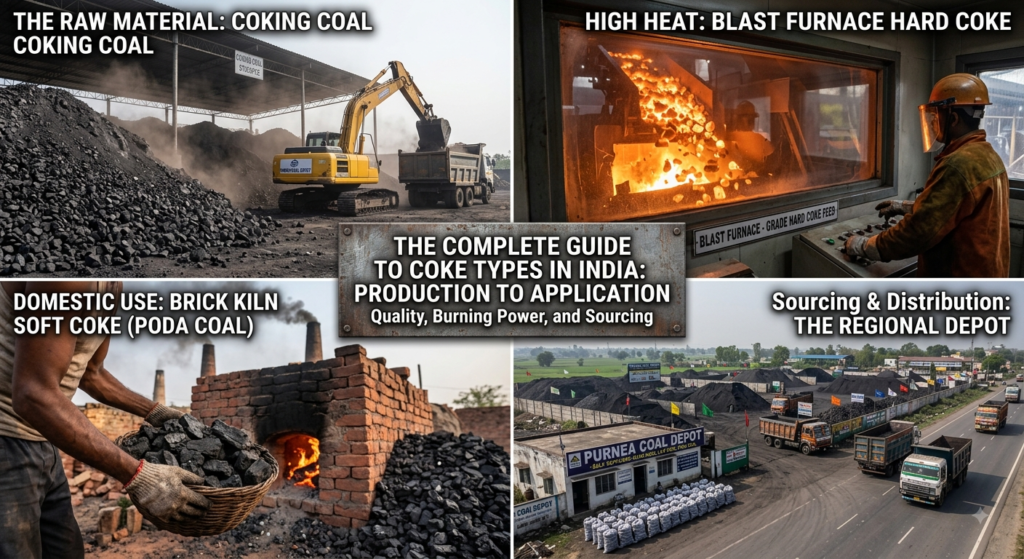
1. Hard Coke (Metallurgical Coke)
- Production: Produced by carbonizing high-grade coking coal at temperatures up to $1100^\circ\text{C}$ in byproduct coke ovens over 18 to 24 hours.
- Burning Power & Quality: Features high mechanical strength (so it doesn’t crush under heavy metal loads in blast furnaces) and high carbon purity. It burns with an intensely high temperature and minimal flame/smoke.
- Availability: Widely available through major industrial supply chains and regional distribution hubs like the Purnea Coal Depot network in Bihar, which supplies raw material across Eastern India and Nepal.
- Best Used For: Iron and steel blast furnaces, foundry cupolas, and heavy forging units.
2. Low Ash Metallurgical (LAM) Coke
- Production: Made from premium imported coking coal (often sourced from Australia or Canada) subjected to strict washing and prolonged carbonization.
- Burning Power & Quality: Represents the pinnacle of coke quality. Its minimal ash content ensures that almost no slag is produced during combustion, leading to maximum thermal efficiency.
- Availability: Highly reliant on imports and major port-adjacent processors; procured regionally by specialized industrial suppliers.
- Best Used For: High-grade steel manufacturing, ferroalloy production, chemical reduction processes, and precision metal casting.
3. Soft Coke (Local Name: Poda Coal)
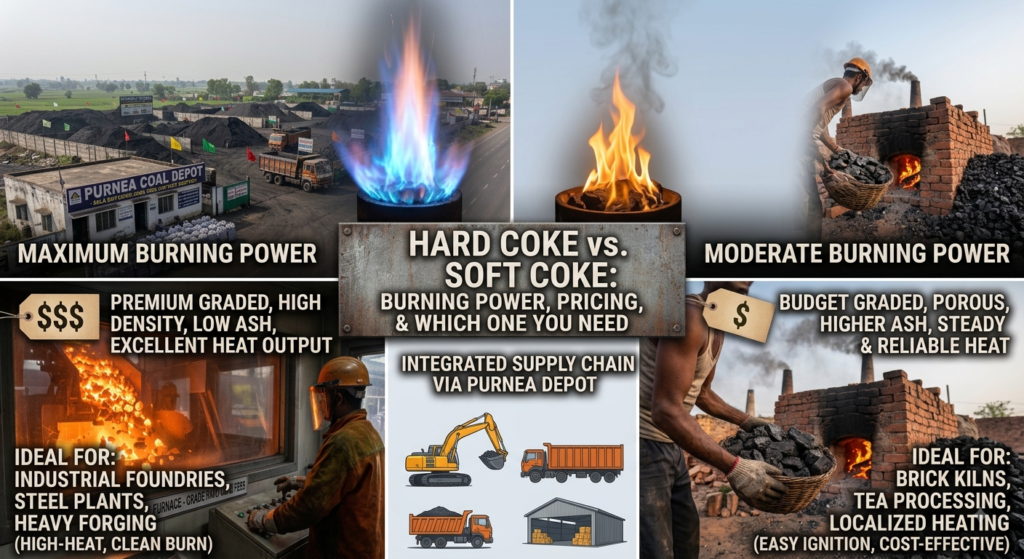
- Production: Derived from low-temperature carbonization of non-coking or semi-coking bituminous coal.
- Burning Power & Quality: Soft, porous, and easily breakable. It has lower thermal power than hard coke due to higher residual volatile matter and ash content. However, it ignites easily without requiring high-pressure air draft systems.
- Availability: Abundantly available across domestic coal depots, brick kiln suppliers, and local markets.
- Best Used For: Brick kilns, tea drying units, localized heating, domestic cooking, and small blacksmith shops.
4. Petroleum Coke (Petcoke)
- Production: A byproduct of the oil refining process (coking units), not coal mining.
- Burning Power & Quality: Exceptionally high carbon content and high calorific value with virtually zero ash. However, it often contains higher levels of sulfur, requiring emission scrubbers in industrial facilities.
- Availability: Supplied via oil refineries and large industrial energy traders.
- Best Used For: Cement kilns, power plants equipped with flue-gas desulfurization (FGD), titanium dioxide production, and aluminum anodes (calcined petcoke).
5. Coke Breeze & Nut Coke
- Production: The undersized screening fragments (usually $<15\text{ mm}$) recovered after hard coke production and handling.
- Burning Power & Quality: Chemically identical to hard coke, but the smaller particle size restricts airflow in large furnaces.
- Availability: Available wherever hard coke is processed or screened.
- Best Used For: Sintering plants in steel mills, fuel briquette manufacturing, and specialized shallow-bed boilers.
3. Selecting the Best Coke for Your Purpose
- For Steelmaking & Heavy Metallurgy: Choose LAM Coke or Hard Coke. The high load-bearing capacity prevents furnace clogging, and low ash preserves melt purity.
- For Brick Kilns & Small Boilers: Choose Soft Coke (Poda Coal) or Steam Coal blends. They offer quick ignition and sufficient heat at a fraction of the cost.
- For Cement Manufacturing: Choose Petcoke, as its high heat output optimizes kiln temperatures, and the ash/sulfur integrates cleanly into cement clinker chemistry.
- For Foundries & Smithy Work: Choose Nut Coke / Hard Coke (20mm–40mm size) for controlled heat output and steady bed pressure.
4. Sourcing & Local Distribution: The Role of Regional Coal Depots
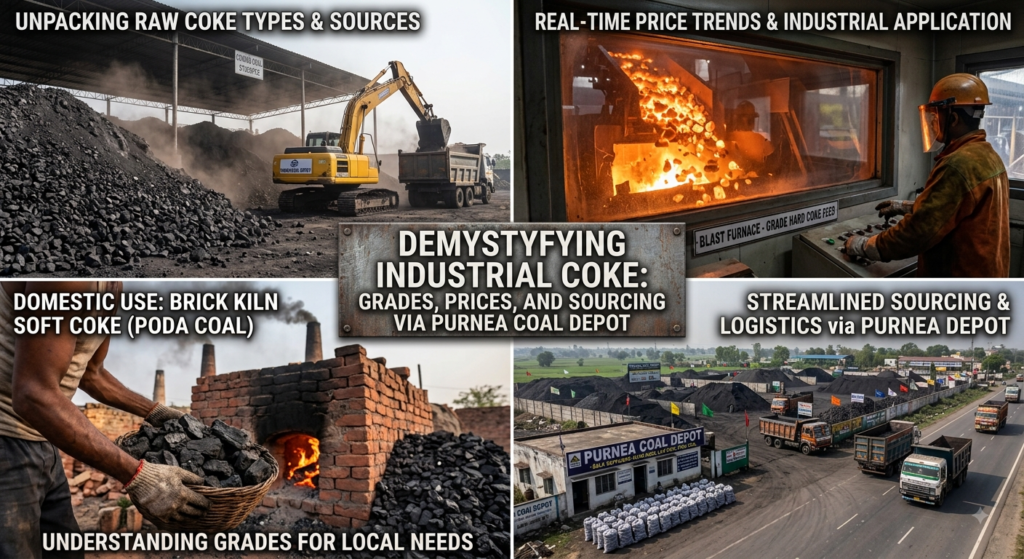
Industrial users, kiln owners, and local businesses rely on strategic supply hubs for consistent access to diverse coal and coke grades.
In Eastern India, hubs like the Purnea Coal Depot network (located around major transit zones like Gulabbagh in Purnia, Bihar) serve as vital links in the supply chain. Situated near major highway corridors connecting coal-rich belts (such as Jharkhand and West Bengal) to Northern Bihar, West Bengal, and neighboring Nepal, regional depots like Purnea allow buyers to:
- Source Multiple Grades: Access everything from high-GCV imported steam coal to local soft coke (poda) and industrial hard coke under one roof.
- Manage Bulk Transport: Bulk shipments arrive via rail or heavy haulage, where local depots screen, size, and package coal/coke for regional distribution.
- Control Freight Costs: Localized stocking reduces transportation overheads for agricultural processors, brickfield owners, and small manufacture units across the region.
You may join my Twitter Account for more news updates, Wordle, and more game answers & hints daily.