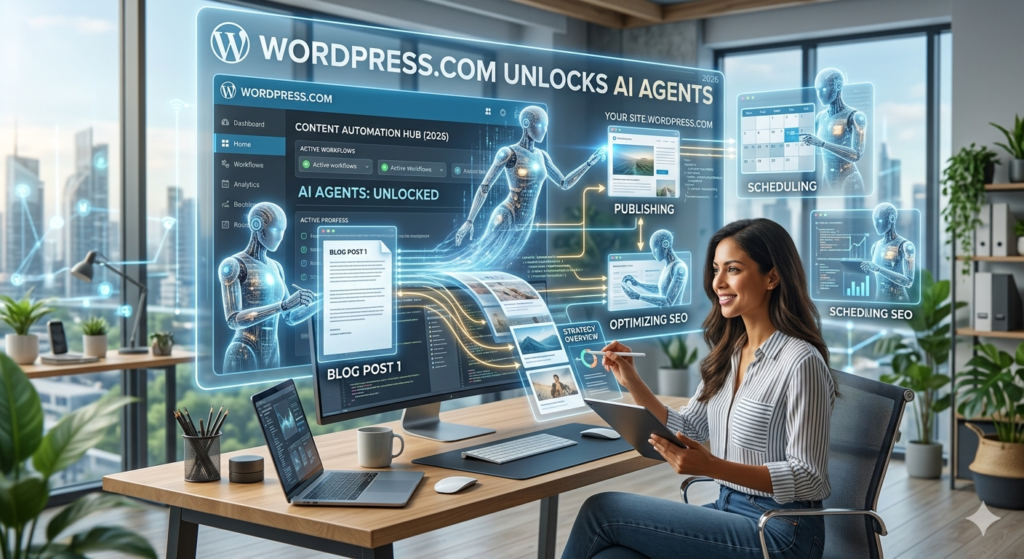
WordPress.com Unlocks AI Agents: On March 20, 2026, WordPress.com officially crossed the rubicon from a passive hosting platform to an active “agentic” ecosystem.
By launching write capabilities for its Model Context Protocol (MCP) integration, the platform now allows external AI agents—like Claude, ChatGPT, and Cursor—to not only suggest ideas but to directly draft, edit, and publish content.
Table of Contents
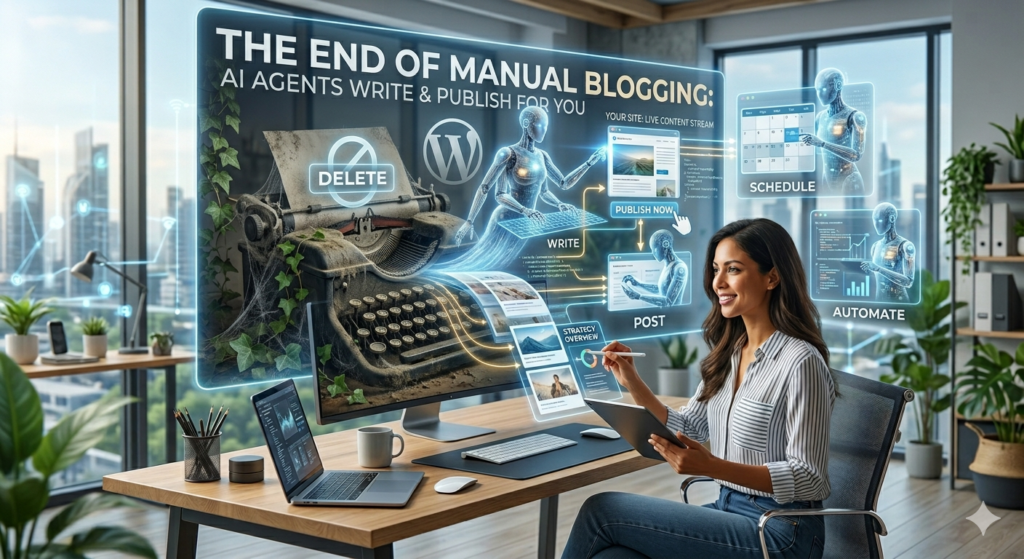
The End of Manual Blogging: How WordPress AI Agents Now Write and Publish for You
This isn’t just a new plugin; it’s a fundamental shift in how 43% of the internet could soon be managed. Here is a deep dive into how this technology works, the “guardrails” in place, and what it means for the future of digital content.
1. WordPress.com Unlocks AI Agents: From “Read-Only” to “Write-Access”
For the past six months, WordPress.com’s integration with MCP (Model Context Protocol) was essentially a high-tech window. You could point an AI at your site to analyze traffic or summarize old posts, but it couldn’t touch the “Publish” button.
The March 2026 update added 19 new operations across six core content areas:
- Posts & Pages: Agents can now generate full layouts, including landing pages and “About” sections.
- Comments: AI can triage, approve, or reply to reader feedback in your specific brand voice.
- Site Structure: You can command an agent to “reorganize my categories” or “tag every post from 2025 with ‘Archive’.”
- Media Optimization: AI agents can now audit your entire media library to fix missing alt text and optimize captions for SEO.
Theme-Aware Intelligence
What makes this “deeply researched” is how these agents interact with your CSS. Unlike a standard chatbot that spits out generic HTML, these agents are design-system aware.
Before drafting a page, the agent “reads” your site’s active theme—understanding its specific colors, fonts, spacing, and block patterns—ensuring the output looks like you built it yourself.
2. The “Human-in-the-Loop” Safeguards
The biggest fear with autonomous agents is a “runaway bot” deleting a homepage or halluncinating 500 spam posts. Automattic (the company behind WordPress.com) built this with a zero-trust architecture:
- Explicit Confirmation: Before an agent executes a command (e.g., “Delete this draft”), it must present a plan and wait for a human “Yes.”
- Draft-by-Default: Every new post or page created by an AI agent is saved as a draft. It won’t go live until you hit the final switch.
- The Activity Log: Every single action taken by an AI agent is timestamped and recorded in the site’s Activity Log, creating a permanent audit trail.
- Role Enforcement: The AI inherits the permissions of the user who connected it. If you are an “Editor,” the AI cannot change the site’s core settings.
3. The “Third Audience” Strategy
The real “meta” move here is Automattic’s preparation for what they call The Third Audience.
- Audience 1: Human readers.
- Audience 2: Search engines (Google/Bing).
- Audience 3: AI agents and crawlers.
By opening up MCP, WordPress is making websites “machine-readable.” This allows your site to not only be found by AI-powered search (like Perplexity or Gemini) but to interact with them.
If an AI agent can “understand” your site structure perfectly, it can serve your content more accurately to users across the web.
4. Why This Matters: The Rise of the “Orchestrator”
In 2026, the role of a “Blogger” or “Content Manager” is shifting from creator to orchestrator.
Instead of spending four hours formatting a table or tagging 100 images, you now manage a “digital assembly line.” You set the strategy, and your agent executes the manual labor.
For small businesses and solo creators, this effectively levels the playing field, providing a “staff of ten” through a single MCP connection.
The Deep Insight: We are moving away from “AI-assisted writing” (which often feels clunky) toward “Agentic Site Management.” The goal isn’t just to write more; it’s to manage the complexity of a modern web presence without the manual grind.
How to Use WordPress AI Agents to 10x Your Content Output in 2026
If you’re on a WordPress.com paid plan, you can enable these features today:
- Navigate to
wordpress.com/me/mcp. - Toggle the specific “Write” permissions you want to grant.
- Connect your agent of choice (Claude, ChatGPT, or Cursor).
The End of the OpenAI Era? Google’s New Antigravity AI Is Finally Outrunning ChatGPT
You may join my Twitter Account for more news updates, Wordle, and more game answers & hints daily.